Written by Gwyn Thomas
Edited by Awais Fareed
In 1995 Lars Von-Trier and Tomas Vinterberg went to the Le cinéma vers son deuxième siècle conférence and unveiled a new filmmaking manifesto labelled “Dogma 95”. The hope of their manifesto was that by making films in accordance with its rules cinema may be purified. In a world where The Matrix would soon send CGI into the stratosphere and cinema was becoming more spectacular than ever before, Dogma 95 wished to bring it back to basics, expecting filmmakers to not lean upon the spectacular narrative or opulent effects, but embrace restrictions that force creativity. The movement was criticized by many for its vague rules and radical philosophies and whether out of reverence or irreverence, Dogma created waves within the independent cinematic space. However, in retrospect it would be a small-scale movement. Only 35 films received the Dogma certification and the amount that had positive critical attention can be counted on one hand. Unlike other seminal new waves, Dogma 95 is a cinematic movement known more so for its principles than any films that were born from them, ultimately dissolving in 2005.
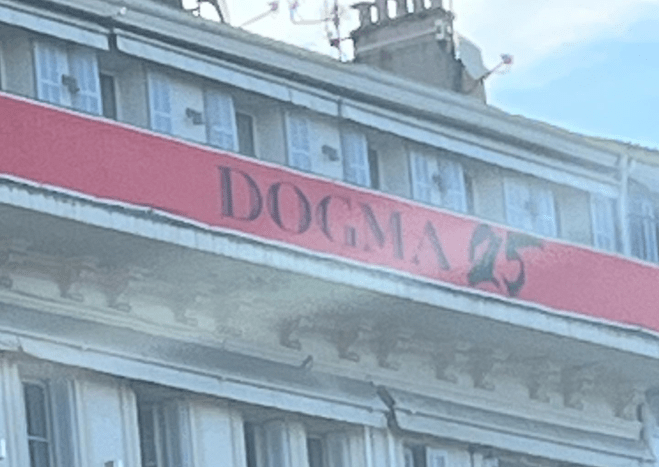
It was because of this, when I walked through the streets of Cannes during the vibrant film festival and saw a giant banner at the top of a building stating “DOGMA: 25”, I smiled. Having thoroughly enjoyed Vinterberg’s Festen and Harmony Korine’s Juliane Donkey Boy I was pleased to see that the legacy of Von-Trier and Vinterberg lives on. DOGMA has been born again. Upon reading their new manifesto, it is clear that this is not the same movement. Although its principles as a reaction against the directions of popular cinema remain, this new DOGMA is strikingly different in its rules and purpose. Not only do these differences open opportunities for more creatively liberated films, but they counter a far more dangerous trend than the opulence Von-Trier and Vinterberg wished to see the death of.
The first difference between the two is that DOGMA: 25 is far more open in both narrative and visuals. One of the largest contradictions within DOGMA: 95 was that despite claiming to be in the spirit of creative freedom, it restricted certain kinds of cinema through the forbidding of “genre films” and banned a huge array of visually expressive tools through blacklisting tripods and lighting states. The new Dogma resists such condemnations, taking the visual and narrative imaginations of the director and letting them run free in the creation of their vision.
The reason the original DOGMA banned these things was because it targeted an issue in front of the camera. Cinema was becoming spectacular, genre dependent and above all else, homogenous. The films Vinterberg and Von-trier saw in cinemas had a palpable aesthetic stagnancy that they wished to reinvigorate by ripping filmmakers from that which led to the issue. The new Dogma removes rules that target content and visuals because the issue they see is behind the camera. With the rapid rise of AI, Marx’s theory of alienation is more apparent in cinema now than it ever has been. Films now have hundreds if not thousands of moving parts and the productions are so convoluted that the film cannot be claimed as the creative vision of any person or group of people. Filmmakers are more removed from the final product than they ever have been, and this has led to the rapid dehumanization of cinema. The final form of this is AI-ification of cinema what may well be the complete separation of film and the humans that gave birth to it. As a result, the DOGMA: 25 rules are focused on downsizing productions to emphasize the importance of authenticity and the human touch. “The internet is off limits”, “no more than ten people behind the camera” and “the script must be handwritten by the director”. By abiding by these rules, the filmmaker produces a work that unlike its predecessor might be formulaic and visually opulent yet remains a quintessentially human film that is devoid of automation. Through this process, this new DOGMA brings humanity back into a cinema that is lacking in it.
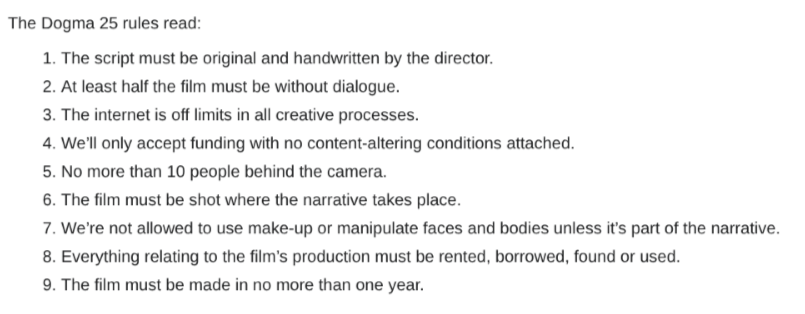
When comparing the two, it is clear to me that its newest manifestation is far more important than the original. When DOGMA: 95 released it was as a counter to a new kind of cinema that they did not like. However, what DOGMA: 25 is countering is the death of cinema itself. If film is art, and art is an expression of the soul then alienation spells the death of cinema. By working within the rules of DOGMA: 95, the filmmaker shakes the tree of cinema by making something that goes against its grain. When working within DOGMA: 25, the filmmaker saves the tree by refusing to be alienated in the process of cinematic production.
This isn’t to say the problems of the first DOGMA do not remain. Rules such as the banning of the internet cannot in any way be enforced or proven, and upholding every rule is a task that is in many ways impossible. However, just like 95, it is the hope that by trying to follow the rules as best they can, the filmmaker may (in the manifesto’s own words) “stand up for the flawed and distinct human spirit”.
Only time will tell if this new DOGMA may produce any films worthwhile, and its true test will be whether its works are better than that of DOGMA: 95. However, in my opinion, this new manifesto is more creatively liberating than its predecessor and its underlying principles are far more important in the saving of cinema. In the words of Vinterberg and Von-Trier in their formal approval of this new DOGMA “we wish you the best of luck in your march towards reconquering Danish film”.

