Written by Nate Cope
Dirty Dancing (Emile Ardolino, 1987) follows teenager Francis ‘Baby’ Houseman (Jennifer Grey) visiting the Kellerman’s hotel in the Catskills with her family during the summer of 1963. What transpires is a summer of self-discovery as she falls for a member of the entertainment staff, Johnny Castle (Patrick Swayze), after he teaches her how to dance so his dance partner, Penny, can get an abortion. Not only is it a wonderfully fun film, it tackles many social issues: an element of the film that is somewhat unusual for the time alongside it’s representations of sexuality and gender. At the heart of the film are the dance sequences and montages, along with the music that accompanies them; specifically in terms of how these sequences allow self-expression and freedom. This is apparent particularly for Johnny for whom dance allows an escape from feelings of alienation and allows potential for social mobility. Despite the differences in their background and situations, dance represents agency and empowerment for both Baby and Johnny.
Contextually, the film reflects and explores two periods in time; the year in which it was set (1963) and the year in which it was made (1987). It is important to consider this when exploring the social issues it addressed for instance one of the central elements of the narrative is Penny’s abortion at a time when it was illegal in America. The film is sympathetic to Penny, condemning people who hold prejudices against her and make assumptions which is particularly crucial at a time in America following the legalisation of abortion in 1973. One of the most blatant comments it sets out to make is that of gender; whilst conventional gender roles are maintained on the dance floor in terms of Johnny physically leading Baby, however, Baby teaches Johnny just as much as he teaches her. Additionally, this raises questions about whose gaze this film exhibits, as Jennifer Grey is much less sexualised than Patrick Swayze, as the film features significantly more male nudity than other films at this time. We may interrogate whether or not the gaze being exerted here is that of a female gaze, as the conventions of the male gaze are subverted through these representations of gender and sexuality within the narrative.
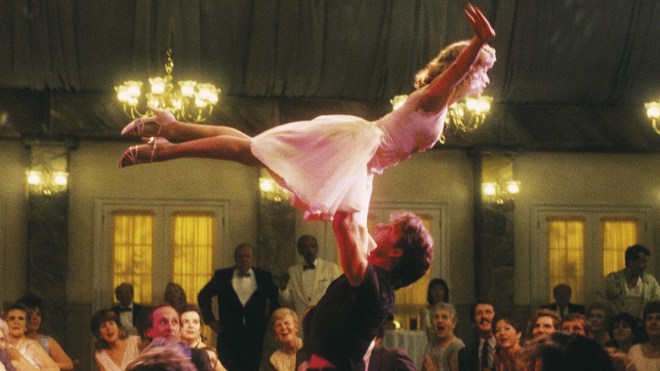
Many of these social comments are conveyed via the musical and dance sequences. Writer and executive producer Eleanor Bergstein states that the narrative itself was largely built around the music, the final soundtrack itself features a combination of what Bergstein calls ‘clean teen’ and ‘dirty dancing’ music that is rooted very much in the 1960s and often can be heard diegetically, and music reflective of the 1980s. Perhaps most notoriously are the songs ‘Hungry Eyes’ and ‘(I’ve Had) The Time of My Life’ that are original tracks on the soundtrack and are played non-diegetically in the film, the exception being in the final dance sequence in which Baby and Johnny dance to (I’ve Had) The Time of My Life’. The transition between the styles of music as the narrative develops represents Baby’s character development as she realises who she is and gains independence through dance and this liberating music and movement. Through these uses of dance and music, Baby’s transition from adolescence into womanhood during this summer of self-discovery is depicted.

