Written by Rowan Li
Edited by Lola Mortlock
Rowan Li explores how Saving Face (2004) tenderly follows two generations of women as they struggle with love, identity, and the pressure to “save face.”
Saving Face is the first film of Chinese-American director Alice Wu. It uses the love story between Wil and her girlfriend Vivian as the main clue to connect the intergenerational conflict between Wil and her mother, as well as the contradiction between traditional Chinese values and Western modern thought.
Wil is a typical successful Chinese-American woman who fulfills all the expectations of the older generation. She has excellent grades and has become a distinguished doctor, yet she is criticized by her mother and other elders for not having a boyfriend. At a family gathering, Wil meets the beautiful and confident dancer, Vivian. They fall in love at first sight and quickly enter a relationship. However, a lesbian couple is difficult for the Chinese community to accept. To keep “face,” Wil feels forced to hide their relationship, which leads to Vivian’s dissatisfaction.
Meanwhile, Wil’s mother becomes pregnant in her middle age but refuses to name the father, leading to her being ostracized by the Chinese community. To save “face,” Wil’s grandfather kicks her out of the house and demands she find someone to marry immediately. With no choices, the mother moves in with Wil. During this process, endless conflicts explode between the mother and daughter. Eventually, Wil confesses her identity as gay to her mother.
The intergenerational conflict begins to ease as the mother’s own love story becomes clear. It turns out the father of the baby is Wil’s friend, Yu. Because of the huge age gap, the mother who always values “face” dares not publicise the relationship and instead follows her father’s arrangement to marry a suitable man. However, at the wedding, Wil stops her mother from remarrying and encourages Yu to confess his love. At this moment, the “face” is finally torn, and everyone finally sees the true hearts.
But before this resolution, Vivian had become disappointed by Wil’s cowardice and decided to leave New York for Paris to develop her career. After the mother breaks through the constraints of “face” and regains her true love, she realizes the value of sincerity. Hearing that Vivian is leaving, the mother strongly encourages Wil to go to the airport to win her back. Mother and daughter rush to the airport together; however, even when Wil finally sees Vivian, she still finds it difficult to express her truest emotions. The weight of love, society, and value systems combined makes it hard for Wil to speak, and Vivian leaves New York.
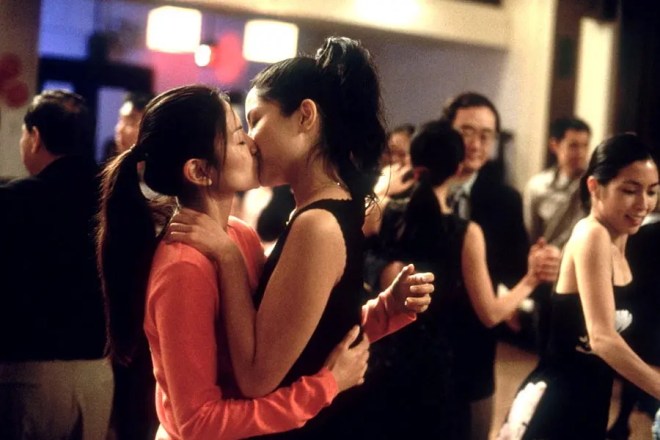
In the final scene of the film, Wil meets Vivian again at the Chinese community gathering. This time, she finally gathers the courage to directly express her love for Vivian in front of all her friends and relatives. They dance and kiss under the gaze of the crowd, while the mother is also happily together with her younger boyfriend. In this most traditional gathering of the Chinese community, all forms of emotion are allowed to exist. No one cares about “face” anymore, only about sincerity and true love. This utopian ending fills the film with a warm atmosphere. When facing the high pressure of traditional concepts and a human relations society, perhaps facing the true heart is the only way out.
 reeltalk0.movie.blog