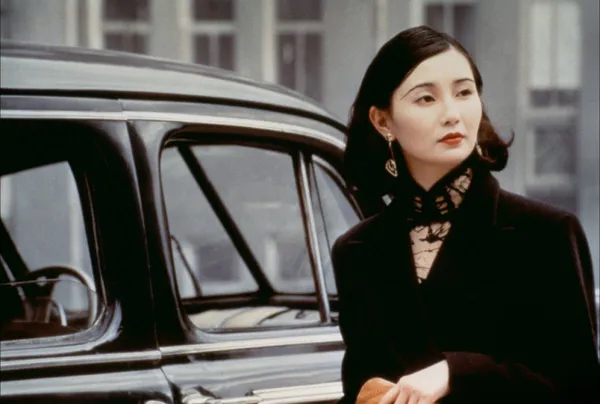
Compelling in its craft, director Kwan’s Center Stage (1991) delves into the public and private life of legendary film star Ruan Lingyu, grappling with themes of identity, gender and stardom.
Written by Rowan Li.
Edited by Lola Mortlock.
Center Stage (阮玲玉) (1991), directed by Stanley Kwan, is a biopic film about a famous silent film star, Ruan Lingyu, in 1930s Shanghai. Ruan was well-known for her beautiful appearance and talented performing skills, but eventually committed suicide because of the gossip about her private life.
The film highlights women’s structural predicament in China during the 1930s in a subtle yet sharp manner. However, the director does not romanticize Ruan as a pure victim, but rather portrays her as indifferent and weak, making the audience realise that Ruan’s tragedy is a result of both the times and her own actions. When Ruan plays those strong and progressive female roles, we see the crack between her weak personality and her on-screen image. The tragic core of these characters echoes her own fate, presenting an ambiguous and tense aesthetic quality between reality and fiction.
The film features a blend of a woman’s life, history, and the modern gaze on the past, presented with a delicate visual style and a feminist perspective. The structure of this film unfolds through multiple temporal layers: Ruan’s life, Maggie Cheung’s performance of Ruan, and the interviews while filming on-set, reminding us that the “history” is not fixed but rather a rewriting in the present context. This film is not an objective realistic biopic; it openly illustrates the subjectivity of film creation. It moves between fiction and reality, allowing the audience to rethink Ruan’s dual identity as an actress and a woman. Kwan reflects the reality and the art world on each other, highlighting that Ruan’s story belongs not only to the past but also to every woman today who struggles against gender, society, and emotions, which expands the feminist theme more deeply.
 reeltalk0.movie.blog