Written by Sonia Naorozy
Edited by Ava Bibb
Since its debut in 2016, Stranger Things has become Netflix’s most successful cultural phenomenon. Its compelling blend of 80s nostalgia, horror and coming-of-age drama has captivated millions globally. This article explores the show’s portrayal of seasonal holidays and how they are used to contextualise and drive the narrative. I’ll also investigate the show’s narrative and structural development under distribution models, particularly in the more recent seasons which increasingly highlights the complex and sometimes problematic nature in which we consume streaming television.
Each season of Stranger Things is strategically centred around one distinct time of year, demonstrating the impact that seasonal holidays have on narrative storytelling and emotional development.
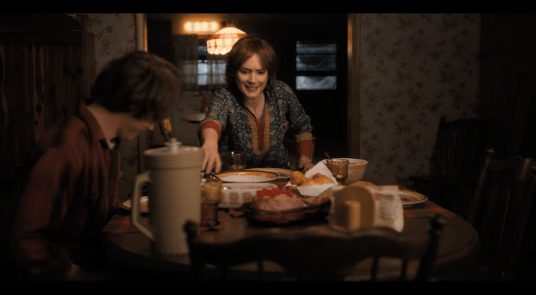
Season 1 follows a party of four young, nerdy kids as they investigate the disappearance of their best friend, Will Byers (Noah Schnapp), leading them to discover an alternate dimension with supernatural monsters parallel to their world. The narrative climax involves a tense escape from government and military bodies, but it is the quiet and familiar hopefulness of Christmas that concludes the season. The final shot shows the Byers family, who are the central victims in the show, gathered for a small Christmas dinner. After the emotional trauma they endured, this moment of domestic peace – Joyce (Winona Ryder) anxiously setting the table, Jonathan (Charlie Heaton) happily taking photos on his new camera, and Will excitedly guessing what presents lie under the tree – provides a sweet and necessary emotional reset after the distressing events of the past season. The festive holiday offers a comforting marker of conclusion and reunion, ending the season on a poignant and unassuming note.
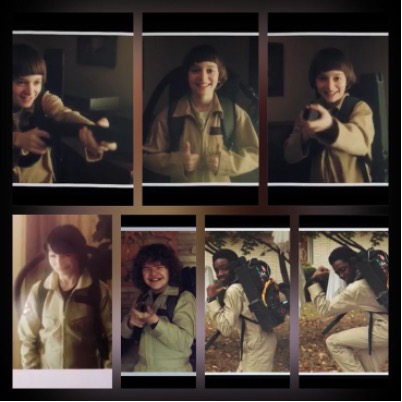
Taking place a year later, Season 2 jumps straight into Halloween celebrations. The holiday works to compound the cast as misfits, being the only ones who turn up to school in costume. Their matching Ghostbusters outfits provide an insight into their own personalities. The sequence in which they pose for photos cleverly demonstrates this, Lucas Sinclair (Caleb McLaughlin) flashes his muscles, Dustin Henderson (Gaten Matarazzo) proudly shows off his self-built prop, Mike Wheeler (Finn Wolfhard) scowls at the bottom of the staircase, and Will Byers grins widely, simply happy to be there. The Halloween setting provides other essential plot elements, such as when an infected pumpkin patches foreshadows a dangerous chemical leak at a lab, and when new student Max Mayfield (Sadie Sink) joins the party for trick-or-treating. Tensions are heightened when a group of Hawkins school kids torment Will, with one memorable scene showing us Will’s first visions of the Mind Flayer as a bully trips him up. These moments are all specific to events that happen during the Halloween season, demonstrating the impact of the holiday to narrative storytelling. Intriguingly, the season’s release on October 27, just 4 days before the actual date of Halloween, immersed the audience in the world of the show by mirroring the time of year and the holiday being celebrated in real life. This engaging distribution strategy sought to elevate the viewing experience.
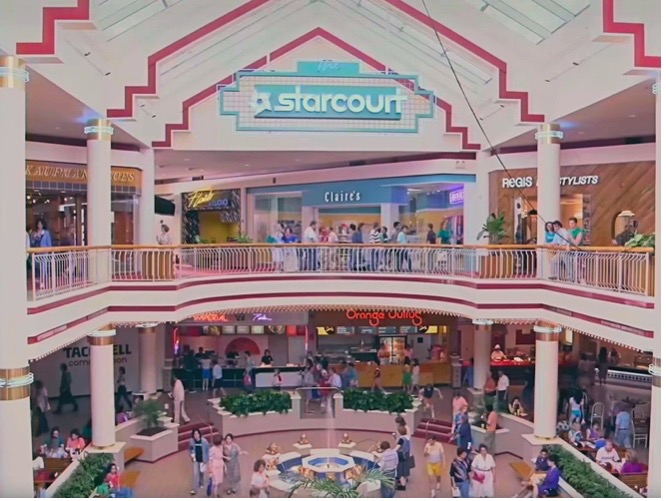
In juxtaposition to the earlier seasons, Season 3 begins at the peak of summer vacation. The newly built Starcourt Mall becomes the popular hangout spot, adorned with teenagers and kids wasting away their days as mall rats. The setting serves multiple narrative functions: it introduces the fan-favourite and playful dynamic duo, Robin Buckley (Maya Hawke) and Steve Harrington (Joe Keery) as co-workers at Scoops-Ahoy!, whilst also crucially being the disguise to an underground Russian lab. The season finale culminates at Starcourt, where the characters meet for one final battle against the Mind Flayer, as they use fireworks (sold on display for July 4th) to fight off the monster in their own Independence Day celebrations. The vibrant, celebratory backdrop of the summer vacation is violently undercut by the supernatural conflict, making the destruction of the mall and climax of the season more impactful.

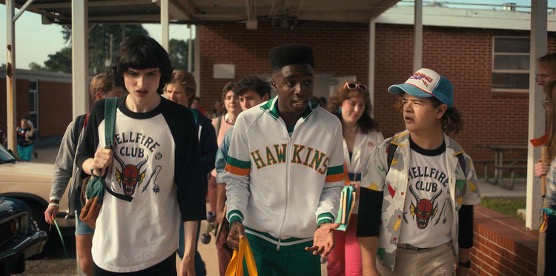
Season 4 opens with a new school year, as the core four navigate the newfound pressures of high school. As they struggle to grasp life as freshman, Mike and Dustin find comfort playing D&D with the Hellfire Club, whilst Lucas branches out to play basketball with the popular jocks. The climax in Episode 1, showing the parallel between the Sinclair siblings in their extra-curricular performances at the school (one at a championship basketball game, the other in the final fight of the campaign), is a clever device to highlight the new identities explored and changes within the group as they grow up and grow apart.
Ultimately, the seasonal structure of Stranger Things demonstrates how holiday celebrations act as both the backgrounds of and the foundations for narrative progression and emotional depth.
Focusing on distribution, the first three seasons follow a tight and compactly written structure, with eight chapters each, averaging around 50 minutes, being released on the same day. This format adhered to the streaming standard, being strongly catered to the binge-watching culture and can be credited for building the cult fan base surrounding the show. However, the approach to Season 4 was entirely different, raising questions about the nature of television production and consumption. Each episode exceeds the length of an hour, and the final two episodes, released later as a part of a separate volume, could easily be considered feature-length films. The last episode, The Piggyback, has a total runtime of 2 hours and 22 minutes. This unprecedented length of quality filmmaking begs the question: how and why is so much effort and resources being put into television?
With Stranger Things‘ production taking at least three years for a mere eight episodes, the lines between television and cinema have been blurred by the show’s writers, the Duffer Brothers. When we consider the levels of filmmaking, writing, and production value, should we be classifying modern prestige streaming shows in the same regard as cinematic releases? The final episodes of season 4 being screened in select movie theatres emphasises this shift. Additionally, the release patterns of Season 5 complicate this. Split into 3 volumes, episodes are to be released in a 4:3:1 ratio, on 27th November 25th December (Christmas Day), and 31st December (New Year’s Eve) entangling the series finale with current holiday celebrations.
The highly anticipated finale is set to bring the story and world of Stranger Things to its conclusion. With the enormous scale of production and strategic use of holidays made to intensify and immerse the audience in their viewing experience, audiences are left to answer the question: will you be celebrating Christmas and New Years this year, or will you be celebrating the Stranger Things finale?
 reeltalk0.movie.blog