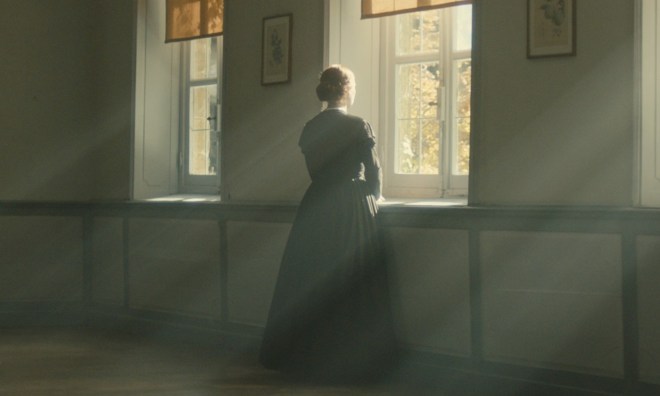
Davies’ biopic reveals Dickinson’s world as both refuge and prison, where poetry becomes her only means of resistance.
Written by Maxime Cushnie.
Edited by Lola Mortlock.
Terence Davies’ A Quiet Passion (2016), a biopic of American poet, Emily Dickinson, is a prison movie of sorts, both in content and form. The film details Dickinson’s life from her early years as a rebellious student, to her sombre, sickly final days. Davies eschews standard biopic plotting, the film doesn’t cycle from one ‘big event’ to the next, rather it zooms in on the quotidian, and from that tries to extract the essence of Dickinson’s life. Which can be summarised as that of a woman born far too early, whose poetry and ideals (as well as her implicit queerness) are incompatible with the world she inhabits. It’s a film where old age, melancholy, disease and death creep up on the viewer as it does on the characters. As Emily’s (already small) world continues to shrink in progressively harsher increments, Davies’ lighting becomes moodier, and the oppressive walls of her home appear more and more claustrophobic.
“Why has the world become so ugly?”, Emily asks her sister, close to death. She has no answer. It is the invisible poison of a society with strict pious and chauvinistic values gradually working its way inside the domestic, corrupting it. One where threats of damnation our launched at any sign of non-conformity, and women are doomed to waste away in their homes. A society which Emily could only ever confront from the confines of her room, through her poetry. Davies commendably resists myth-making, reducing Dickinson’s life to one that was tragically indicative of those of many other women in 19th century America, whilst still repeatedly emphasising the beauty and intelligence of her poetry, by having Cynthia Nixon, who plays Dickinson (and who does so with such heart-breaking sensitivity), read out carefully chosen excerpts of her poetry over carefully chosen moments in her life.
 reeltalk0.movie.blog