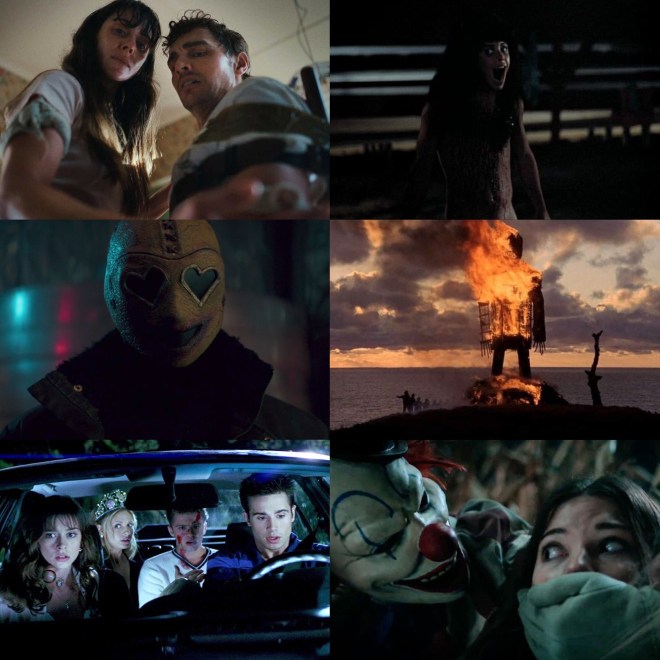
One of our two themes for this term at Reel Talk is ‘Seasonal Horror.’ Our editors have contributed some of their favourite seasonal horror films, ranging across all seasons and horror sub-genres. As a result of all of the amazing submissions we have received from our editors, I will be organising their posts into two separate posts on the blog. The first will revolve around seasonal horror films set during the New Year’s winter months (January and February), to horror set in Spring, Summer and the beginning of Autumn (before Halloween but where the Halloween vibes are already strong). Keep an eye out for the second part of our ‘Seasonal Horror’ post, which will be published this Friday and will concern seasonal horror set during Halloween and the period around Halloween, Late Autumn, Winter and the Christmas period. If that is not too much seasonal horror for you, our ‘Seasonal Horror’ zine, created by members of the Reel Talk editorial team, will be comprised of these films as well as some fun quizzes and games, and will be released in its physical form at our end-of-term Christmas party.
Edited by Awais Fareed
Katie Chadwick on Heart Eyes (2025)

When it comes to Seasonal Horror, our minds often jump straight to Halloween horrors, Christmas thrillers, or even the Summer Camp trope of slasher films. Yet, there is a holiday sometimes forgotten in the cold winter months of a new year, St. Valentine’s Day.
Heart Eyes is a 2025 Rom-Com Horror film depicting a serial killer who targets couples on Valentine’s Day. We are introduced through the journey of Ally (played by Olivia Holt) and her failed attempt at marketing jewellery. She then meets Jay (played by Mason Gooding) as he comes into her work to save the day as an award-winning advertiser, after an adorably awkward meet-cute in a coffee shop. This professional battle is stunted as they are forced to fight for their lives at the hands of this masked serial killer nicknamed “Heart Eyes”. Targeted by the murderer despite the pair lacking any romantic involvement, this battle to survive, however, becomes their first date. What the film lacks in its script and acting initially is made up for by the film’s brilliant action-horror sequences and special effects, creating some brilliant gore sequences. Heart Eyes showcases brilliant fight choreography and unique death scenes. Yet, as it is a Valentine’s Day Rom-Com after all, we are also treated to a beautiful shopping montage as best friends try to decide Ally’s outfit for her work date.
The connection between that February 14th Holiday and the Horror genre is undeniable, stay with me, as horror and romance share the same key values and iconography. What makes your heartbeat? Makes your blood pump or gives you butterflies in your stomach? Well both making eye contact with your crush, or being chased by a masked serial killer of course….
Well the mask may cause conflicting feelings for some people anyway, looking at you BookTok and Scream fans…
It makes you wonder if there is more to this connection than just shared emotional responses, that perhaps the film is giving a commentary on the modernised dating scene, which has undergone mass media convergence in the past decade or two, using dating‑app optics to modernise the “couples under siege” trope. Perhaps the real horror is using algorithms to meet potential life partners. As well as this, it could be providing a social commentary on the male loneliness epidemic and femicide. Women face huge threats and dangers in the dating scene, often at risk of violence or assault. For men, technology only reinforces their isolation and struggle to open up/be vulnerable with friends, instead of encouraging discussion and companionship.
Ruben’s Heart Eyes offers a lovely break from the typical themed/seasonal horror films with a unique genre blend of rom-com and horror, centred on a holiday which celebrates love and romance. And if you can get past the direct-to-video nature of the film and certain cringeworthy scenes, it is well worth a watch. ❤
Hannah Byrne on Together (2025)
I have very mixed feelings about 2025’s ‘horror film of the year’, Together, Michael Shank’s directorial debut. It is a well filmed horror, with a fantastic concept, great suspense and lighting. The pacing is not the best. Everything is wrapped up in a rushed final half with a flat ending, which is a shame given the unique premise of the film.
Tim (Dave Franco) and Millie (Alison Brie) are a codependent couple who have been together for so long that they aren’t quite sure what they liked about each other in the first place. Like all couples in this genre, instead of healthy communication, they move into a creepy house in the woods. After drinking some strange water in a cave on a hike, as you do, they begin to slowly start to fuse together.
There are some fantastic moments of body horror which are absolutely cringe inducing. Have you ever made a joke about a couple you know fusing into one person? This takes that very literally, making it the perfect dark Valentine’s film! If you’re single, you can revel in the film’s humour as it pokes fun at toxic codependency. If you’re taken, there may not be the same appeal, but you can be relieved that Franco and Brie’s marriage survived while filming this.
Jamie Pakes on The Wicker Man (1973)

Spring may seem a strange season for horror, associated far more with rebirth, nature and Sunshine than death, danger and darkness. But this is where folk horror can step in, a genre which often takes the beauty of a Spring or Summer landscape and laces it with an ominous edge. The Wickerman is generally regarded as one of the earliest and defining folk horror films, forming an unholy trinity along with Witchfinder General (1968) and Blood on Satan’s Claw (1971). Police Sergeant Howie is sent to the remote island of Summerisle to investigate the mysterious disappearance of a little girl. He arrives on the idyllic island expecting full cooperation, but is told by locals that the little girl never existed. This is impossible, and soon his investigation spirals into paranoia that the whole island is in on some sinister plot to sacrifice the young girl to their Pagan Gods.
Everything about the island seems slightly off. It is perhaps too idyllic. The people live too harmoniously, they are too happy, and he island’s leader, Lord Summerisle, seems almost too beloved, emphasised by Christopher Lee’s off-putting but undeniable charisma. This creates a unique kind of horror less interested in jump scares than in making the viewer question their own sanity. Since the horror is so hard to locate, impossible to directly put a finger on, the viewer can never fully confront and therefore dispel it.
As the film goes on and the island seems to remain the joyous, peaceful bastion of an older Scotland, the viewer begins to question their own judgment of this place. The best of folk horror often comes when faced with the notion that the dichotomy between monster and victim isn’t as clear-cut as it may at first seem, forcing the viewer to question the ideals that have made them judge this seemingly innocent Pagan community so harshly. The Spring setting only emphasises this, associating the islanders with Sunny days and blooming flowers rather than the typical darkness and decay. By the time the film was over, many viewers found themselves siding with the islanders, identifying with them far more than the stuffy, rigid, moralistic Howie. Based on interviews with director Anthony Schaffer, it seems that this was not the intended effect, which only serves to make it more fascinating, as if the islanders have taken on a life of their own and are reaching through the screen to the viewer.
Is Summerisle really just a tranquil, slightly eccentric Pagan community? Or is there something evil lying behind those rolling hills and smiling faces? It is this question that haunts the film and makes it so memorable that it became instrumental in spawning a whole subgenre of horror. As to its answer, I will leave that up to you.
Char Taylor on I Know What You Did Last Summer (1997)

I Know What You Did Last Summer, credited with reviving the slasher genre alongside Scream in the 90s, is a summer horror classic. Set in a small coastal fishing town in North Carolina, the film’s promise of teenage freedom—fireworks, parades, late-night beach trips and drives—is quickly shattered by a drunken mistake made by four friends. They try to bury their secret, only for it to be unearthed a year later, threatening to put an end to their seemingly endless, magical summer.
Our protagonist Julie James (played by Jennifer Love Hewitt) returns from college to find that the tragedy has torn her friends and their lives apart, leaving them stagnated and lost. The film’s bright coastal setting contrasts with the building sense of dread—no twisted forests, dilapidated houses—just the vast roads, beaches and a close-knit community, open and vulnerable to the tragedy that creeps in during the town’s celebration of Independence Day. Whilst the villain of the film, a vengeful, hook-wielding fisherman, may not have reached Ghostface levels of iconicity, he certainly makes for a solid slasher killer. Loosely based on the urban legend of the Hook, his mystery identity, shrouded by a black Sou’wester hat, provides us with that extra special touch of mystery and teenage drama.
I Know What You Did Last Summer is more than just your typical, camp slasher with an all-star ensemble cast (Sarah Michelle Gellar as Helen Shivers is my perfect scream queen). It is a tale of consequences to foolish teenage actions, relying less on visceral horror and gore, and more on the terror of lingering guilt and regret.
Anna Tilley on Sleepaway Camp (1983)

Released in 1983, in an off year for horror, Sleepaway Camp is about as camp as its name suggests. It has all the hallmarks of a low-budget indie horror film; men in crop tops and short shorts, terrible – but inspiring – practical effects, and some iffy morals. The characters are all stereotypes of themselves; the ‘slut’ camp counsellor who picks on the quiet protagonist (Angela), and the well-meaning adults who inadvertently cause more harm than good. While not initially well-received by critics, the film has since garnered a cult following within the horror community.
Sleepaway Camp hits the spot if you’re in the mood for some mindless violence and gruesome kills, all until its final scene. A haunting freeze frame of Angela naked and screaming reveals that she was never in fact Angela. Her brother was the one that survived in the opening scene’s boat accident, but their eccentric aunt didn’t want another son, so she raised Peter as Angela to satisfy her desire to have a daughter.
This can be read as an attack on transgender people because the film’s antagonist, and murderer of at least ten people, was someone who doesn’t conform to traditional gender expression (whether by their own choice or not). The fact that this revelation occurs in conjunction with Angela being outed as the murderer inherently links the two, implying that not truly being a girl is just as bad as killing children! Some argue that the twist could be blaming the strict gender roles enforced upon children for violent outbursts such as Angela’s, or even just bullying. But, even so, the final scene’s graphic nature uses Angela’s body for shock value, suggesting that she is abnormal and freakish. As such, Sleepaway Camp is regarded as offensive by today’s standards.
Awais Fareed on Clown in a Cornfield (2025)

Clown in a Cornfield is a perfect Autumn and Halloween season watch or just a fun watch in general. The film is set during Autumn, which makes it a perfect addition to the discussion of Seasonal horror films. The film, which is based on the book series of the same name by Adam Cesare, revolves around seventeen-year-old Quinn Maybrook, who has just moved to the town of Kettle Springs after the death of her mother. This seemingly quiet town presented the perfect opportunity for a fresh beginning, with her dad being hired as the new town doctor. A lot of the tense terror of this film takes place in the town’s cornfield; a particularly terrifying scene from the third act springs to mind. The film uses the trauma of the town’s factory burning down to its advantage, with the iconic figure associated with the factory and thus the town, Friendo the clown, being the film’s primary villain. Friendo the clown goes from being the faux villain of Quinn’s friends’ horror YouTube videos to being a very real threat and villain. Without spoiling too much, the film takes some interesting and unexpected turns, has some pretty fun jokes, a distinguishable horror villain, likeable characters and tantalisingly creepy scenery. It is not the stereotypical “small town is evil” film I was expecting, but it is a rather distinctive slasher film that is a perfect entry into the teen horror canon. A pleasant surprise, and I hope to see the sequels getting adapted soon.
 reeltalk0.movie.blog