Written by Jake Diamond
I am Legend is a film about the human condition in isolation, masked underneath a simple apocalyptic vampire narrative. As the third adaptation of Richard Matheson’s original novel of the same name, it shares only a bare-bones structure: in The Last Man on Earth Dr Robert Neville must attempt to find a cure for a global pandemic which has killed almost everyone, leaving the few survivors to turn into vampiric creatures known as ‘Dark Seekers’. The original novel, released during the paranoia of the cold war, is a work of anti-war fiction, focusing on actual warfare, biological warfare, and religious warfare. This 2007 adaptation however, that came out during the oversaturated vampire zeitgeist, focuses much more on the idea of being alone, with the night time creatures acting as a simple, often unseen, catalyst.
Though one could draw ideas of the “new warfare” of the early 2000s where the enemies are unknown due to guerilla warfare and online warfare, I believe the film is much simpler than that, prioritising one of the deepest facets of horror, one of the deepest fears we often never confront: being completely and entirely alone.
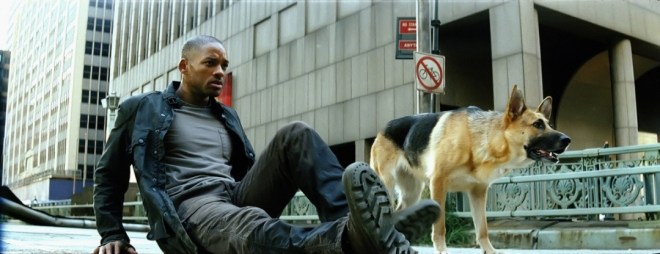
With this idea in mind, Will Smith becomes the conduit for the horror of the film. He carries the entirety of the runtime, captivating you with a complex and visceral performance. He conveys years of torment with a fleeting look and internalised angst with subtle words transcending his stardom to truly become Robert Neville. When his performance is not the main feature, the master shots of an abandoned Manhattan are haunting and atmospheric and are used to truly perpetuate the scale of the narrative’s pandemic. This additionally adds a sense of realism to this science-fiction tale, presenting a globally known mega-city as a barren wasteland, helping to ground the plot.
The soundtrack, which must not go un-mentioned, fills the void in the quieter moments of the film where we see Robert doing his daily activities. The rousing score of minor tones helps to deepen our understanding of Robert’s inner turmoil that he has no one to show. Though the filmic presentation is sublime along with these intimate introspective scenes with our protagonist, the sequences featuring the darkseekers are less desirable. Their dated CGI can instil a horrific sense of the uncanny valley, but this is more likely to pull you out of the experience than to create genuine fear for Robert’s safety. Their true terror surfaces when they are off-screen, lurking in the shadows of the barren buildings. As a viewer, knowing that they must come out when the sun goes down, a one-hundred percent certainty of every day, there is always a sense of stress for Robert concerning whether he will be able to get to his fortress in time. With this in mind they become much more representative of isolation, forcing Robert to hide for half of his life within his cramped shelter whether we see them or not. This large change from the source material, where the dark seekers are ever-present knocking at Robert’s door, creates a larger sense of horror, it’s what we don’t see that terrifies us most, and what we do see is a man in a perpetual cycle of loneliness and survival: a horrifying scenario to arbitrarily place ourselves in.
 reeltalk0.movie.blog