Posts written by Elizabeth Dykes, Aaron Jagger, Jamie Pakes, James O’Connell Nash, Linh Duong and Michael Maxwell
Edited by Michael Maxwell and Jamie Pakes
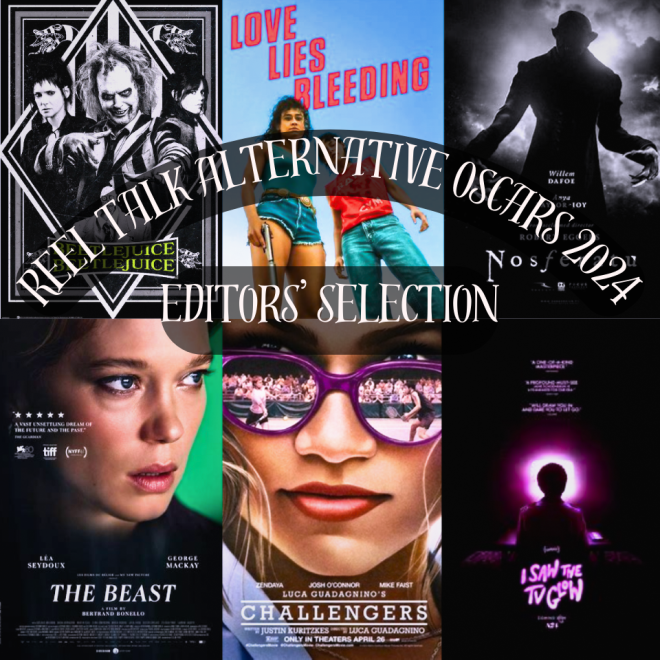
As the 97th Academy Awards rapidly approaches, so does Reel Talk’s annual Alternative Oscars, in which the votes of Warwick Film and Television staff and students determine our favourite films of 2024. To celebrate the launch of our poll on Moodle, six of our editors have laid out their praise for some of our favourite films of the past year, including the specific traits that we believe should earn them, at the very least, strong consideration for an award. After reading this article, feel free to head on over to the online poll and cast your vote! (Note that only Warwick Film and Television students and staff can vote).
The following are our recommendations for your consideration for Best Film in alphabetical order:
Elizabeth Dykes on I Saw the TV Glow (Jane Schoenbrun)
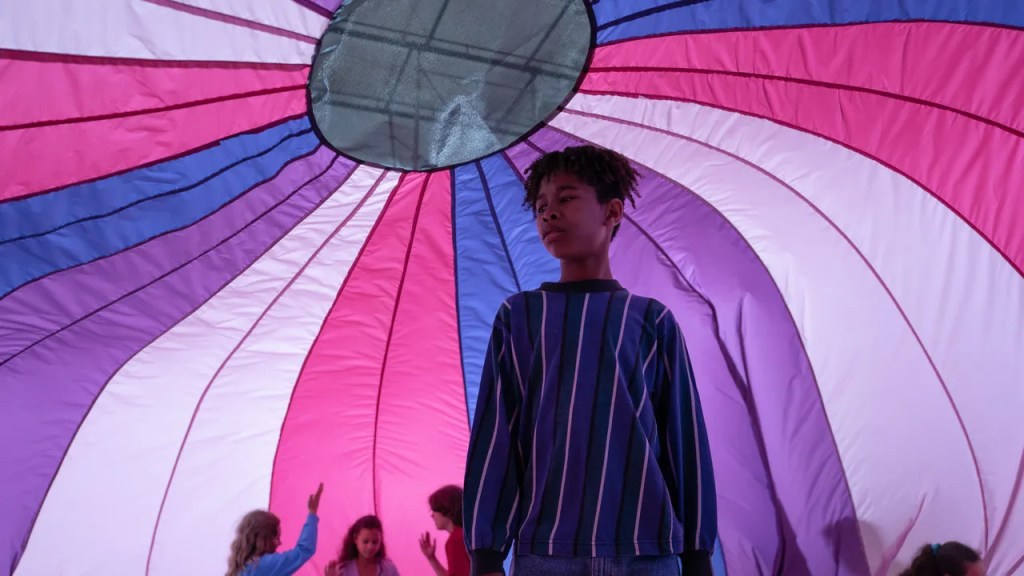
As a trans woman, the choice of film to recommend for this year’s (vastly superior) Alternative Oscars feels almost non-existent; of course I’m going to pick Jane Schoenbrun’s I Saw the TV Glow. It is a work unapologetically for and about trans people, steeped in the soft neon-glow and VHS effect that so deeply resonates with many lived queer experiences (the internet in all its anonymity acting as a refuge to explore identity and escape into a self-actualising fantasy). Moreover, Jane refuses to follow the cisnormative dialogue of transness as a straightforward line of transition, one with a cliched Hollywood ending, where the protagonist passes as a woman, or a man, or whatever box that people are most comfortable putting them into.
The horror at the core of the piece is that of being an ‘egg’, a term used in trans circles for those who are trans but have not yet realised or accepted it. The hero’s journey is rotted with ennui: time falls in on itself, a life passing in minutes; Owen/Isabel refuses the call to adventure time and time again, begging for Maddy, for their mother, for anyone to make the leap easier; the third act is missing. The malaise of an individual unable to transition (either for social, monetary or psychological reasons) is woven formally into the piece. Only at one moment does Owen/Isabel acknowledge who they really are, cutting their chest open after a panic attack at their job. Noise (digital) seeps through the tear, revealing her hollowness/wholeness. She is full of static and where there is the emptiness of his life there is also the potentiality for beauty. Even as (s)he stumbles out of the cinema, gasping for breath unable to go through with the death/rebirth of being buried alive, graffiti on the street reminds us that, ‘there is still time’. In a world ever increasingly hostile to non-cis identities it is our stories that connect us, our visibility that makes our strife known, which is why films like I Saw the TV Glow are now more important than ever.
Aaron Jagger on Love Lies Bleeding (Rose Glass)
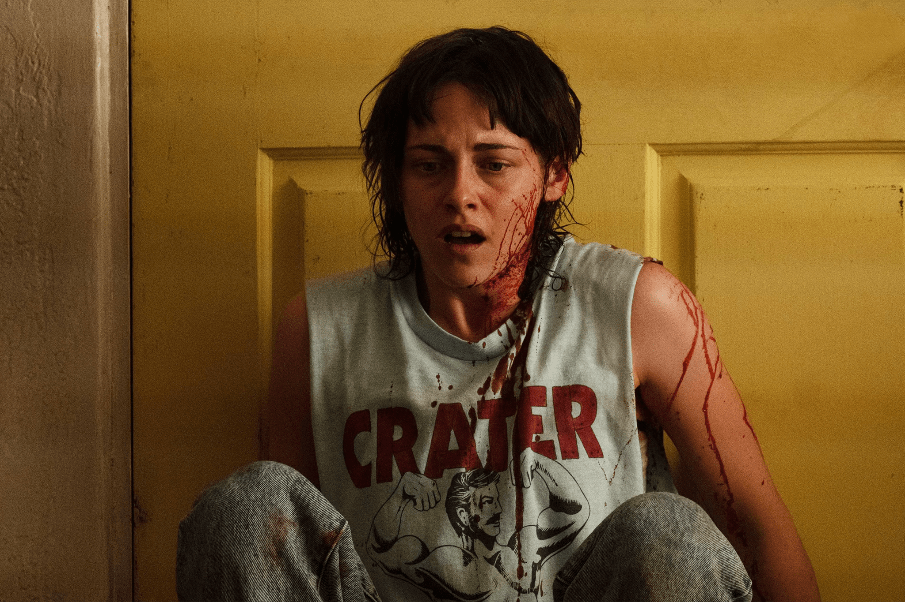
The Academy rather famously has an issue with horror films. This is reflected in the shocking statistics that to date, Silence of the Lambs in 1992 has been the only horror film to win Best Picture and is only one of 7 horror films nominated for the Best Picture award in Oscar history. That 7 does include this year’s nomination of The Substance for consideration of the top award, along with a Best Actress nomination for comeback star Demi Moore. However, there were a slew of fantastic horror films this year, including those female-directed and female-driven. The biggest snub of the year for me was Rose Glass and her body horror-come-thriller, Love Lies Bleeding.
Gym manager and daughter of a crime family Lou (Kristen Stewart) eyes up Jackie (Katy O’Brian), a bodybuilder in the pursuit of fame through her muscles. The two become tangled in a web of blood, sweat, and steroids as Jackie begins using drugs, and is hired by Lou’s father (Ed Harris) to work on his gun range. Push through the brutality of the past and the pressures of small-town living however, and you come to the startling assertion by Glass, Stewart, and O’Brian that butch lesbians are not only desirable but can fall for each other, hard. With a touch of magical realism and the squelching transformations of body horror, Love Lies Bleeding is a radical testament to lesbian love and survival. Kristen Stewart delivers her best performance to date and Glass reminds us that 2019’s Saint Maud would not be the last time we would hear from her. Hopefully, this year the Academy can shine a light on horror, particularly where it is female-created, and start to look under the skin of what makes this overlooked genre so raw.
Jamie Pakes on Nosferatu (Robert Eggers)
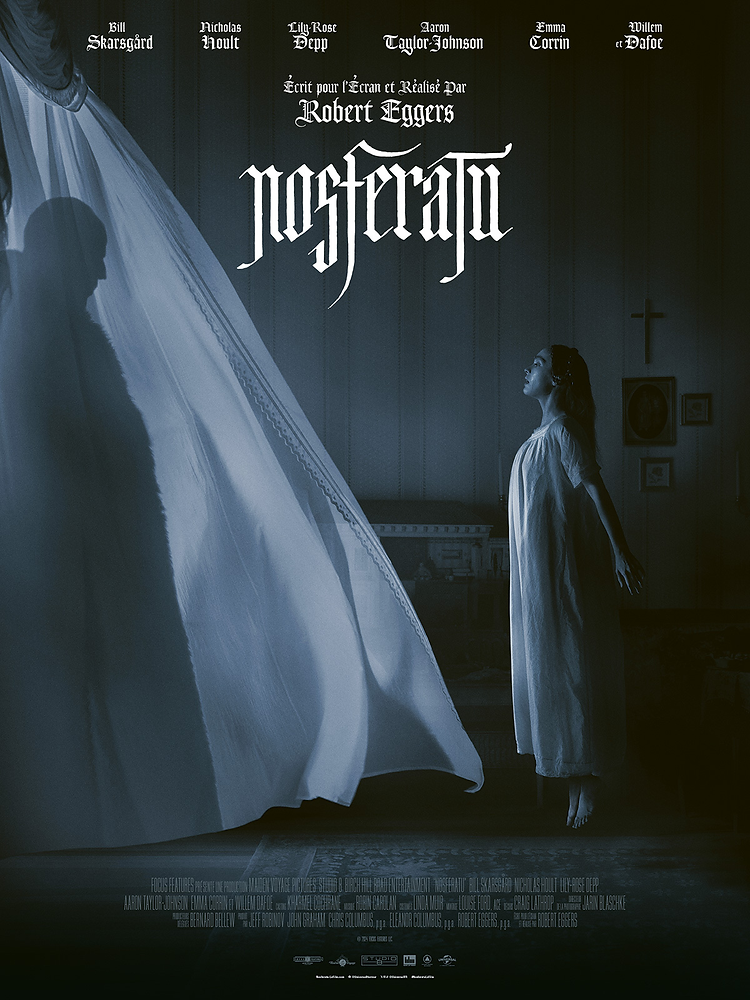
Nosferatu (Robert Eggers, 2024) has proven one of the more divisive films of the year. For some, it was too slow, uninteresting and in some cases simply too strange. However, for me, it’s one of the greatest films released this year, and another incredible addition to the catalogue of Robert Eggers, who is quickly becoming one of my favourite directors. I’m a sucker for a film with a strong atmosphere, and this one is absolutely dripping with a beautiful yet often harrowing Gothic aesthetic.
The restraint shown throughout the marketing campaign in concealing Bill Skarsgård as Count Orlok pays off, as much of the film’s first act gradually builds up to his reveal. David White, Traci Loader and Suzanne Stokes-Munton earned a nomination for makeup and hairstyling, which is largely down to their work creating Orlok. This Oscar-nominated contribution pairs with Bill Skarsgård adding another incredible performance to his building oeuvre of monstrous roles, to create a truly terrifying, menacing villain who restores terror to the figure of the Vampire, heavily diluted in modern pop culture.
Lily-Rose Depp’s performance is one of the aspects that I’ve seen subject to debate. Some find her slightly ridiculous in the lead role, but for me, her delivery of Ellen’s torturous experience is believable and suitably horrific. Elsewhere, Nicholas Hoult seems born to play a mortified 19th-century man, acting as a vehicle for the audience’s own terror as he trepidatiously tiptoes into Orlok’s haunting castle. And as is to be expected by now, Willem Dafoe is fantastically eccentric and engaging as a professor of arcane arts.
Nominations for makeup, production design, cinematography and costume design point to the strength of Nosferatu’s atmosphere, and this gripping Gothic atmosphere is what makes it one of 2024’s best.
James O’Connell Nash on The Beast (Bertrand Bonello)

No new film I watched in 2024 spoke to the malaise permeating contemporary life, the dread that we no longer have any future to speak of, quite like Bertrand Bonello’s The Beast. A loose adaptation of Henry James’s novella The Beast in the Jungle, Bonello’s film begins, after a viscerally terrifying opening in front of a green screen, in the year 2044.
In a world governed by artificial intelligence, Gabrielle (Léa Seydoux, in a performance whose sustained grace and subtlety makes moments of passionate love and terror all the more cutting) is forced to undergo a procedure to deaden her emotions in order to secure a better job. While undergoing the procedure, however, she is transported to two past lives, both circling around doomed romances with a man named Louis (George Mackay), whose path she briefly crosses in the film’s opening. In 1910 Paris, they conduct an affair within elegant high society; in 2014 Los Angeles, Gabrielle is an aspiring model and Louis an incel stalking her while descending into madness.
Both settings are poised on the brink of catastrophe: the Parisian characters nervously anticipate a flood of the Seine that is symbolic of the looming war and destruction of Old Europe, while the 2014 sequence captures a world on the precipice of the socio-political alienation and chaos amidst which I have grown up. No such looming change is apparent in 2044, where Gabrielle frequents a club that allows her to live vicariously through various twentieth-century decades and styles, and in which any passion, good or bad, is stamped out.
Capturing the zeitgeist earnestly and without pretension, The Beast speaks to very current anxieties that history is ending all around us, not with any decisive moment, but with a retreat into affectless passivity, a blank-faced resignation more petrifying than any cataclysm.
Other awards
Following this selection, we have two choices for specific awards, namely Challengers for Best Original Score and Beetlejuice Beetlejuice for Best Costume Design.
Linh Duong on Challengers (Luca Guadagnino)

Luca Guadagnino’s Challengers is a phantasmagoria audio-visual experience, playing a game with its own audience as we follow the messy but all the more captivating love (interdependent, manipulative) triangle between three tennis players. The film is composed of some of the most visually innovative and camp-framing for a tennis match ever, furthered by the iconic soundtrack composed by Trent Reznor and Atticus Ross. The soundtrack unabashedly proclaims itself as one of the most innovative and dynamic scores ever made for film, with Guadagnino’s mastery at blurring genres and tones coming across in the soundtrack perfectly. The electronic techno soundtrack captures the tension of the tennis match and the chemistry between the trio in the most energetic and in-your-face way possible. The droning, throbbing beats are juxtaposed and heightened with pulsating synths, overwhelming the audience as a track would at a rave. It leaves the audience overstimulated and hungover as if you’ve just been on a wild night out.
Challengers fully embraces the potential of its medium, with the film drawing attention to its own soundtrack and construction. Even after the release of the film, Reznor and Ross’ work remains an iconographic piece of work. It is instantly memorable and instantly recognisable, cementing itself within the audience’s minds and the cultural landscape of Summer 2024. It is overwhelmingly cinematic in all the best ways possible.
Michael Maxwell on Beetlejuice Beetlejuice (Tim Burton)
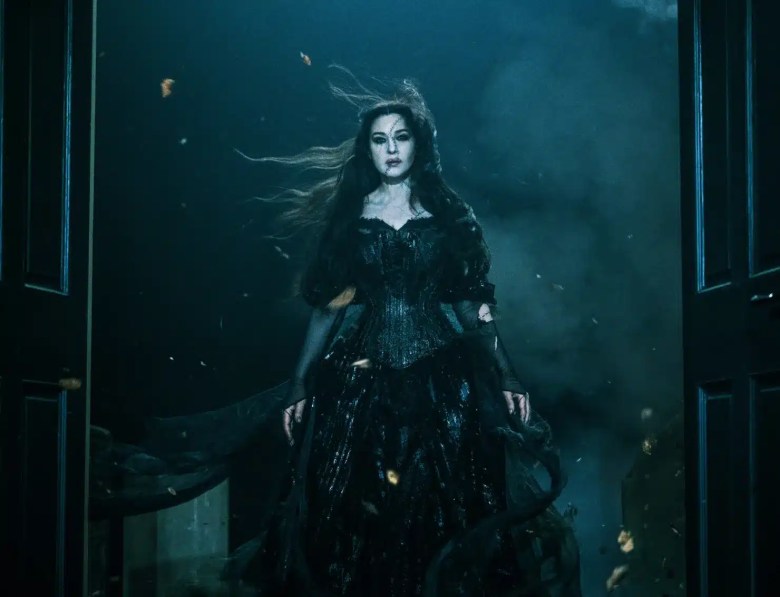
Beetlejuice Beetlejuice (2024) was the long-anticipated sequel to the iconic 1988 film, with Tim Burton returning to direct. Harkening the original film’s costuming with the return of Lydia Deetz’s (played by Winona Ryder) red wedding dress as well as Betelgeuse’s (Michael Keaton) striped suit and crimson tuxedo, the costume design evokes a sense of nostalgia for those familiar with the previous instalment. The wedding scene is referenced and remade towards the end of the film, the synchronisation of Betelgeuse’s and Lydia’s red wedding clothes providing a sense of symmetry within the scene and with the previous film. While Betelgeuse’s black-and-white suit is the more iconic of his costumes and does return in the film, his crimson tuxedo brings about the biggest payoff.
The costume aesthetic is commonly referred to as glam-goth, rooted in the 1970s and ’80s when goth evolved from punk and glam-rock fashion subcultures. No character in the film more exemplifies this aesthetic than Monica Bellucci in her role as Delores LaFerve, Betelgeuse’s ‘ex’. She spends the entirety of the film wearing a handcrafted black wedding gown designed by Colleen Atwood, a titan of the costume industry and frequent collaborator with Tim Burton. The makeup and costume departments worked together to produce the incredible finished effect of Delores. Her pale skin accentuates the mismatched lines of staples adorning her body. Her eyes look almost black from eyeshadow and eyeliner, combined with the dark-red lipstick. The dress is tattered, as are the sleeves that she wears. All of these elements come together in meeting this glam-goth aesthetic. Winona Ryder, of course, was known to be a style icon for the goth subcultures due in no small part to her relation with the first film. I wonder whether the film’s costuming will provoke a renewed interest in goth fashion, and thus I put forward this film for your consideration in the Alternative Oscars.
Thank you for reading! Please head over to the online poll so that you can cast your vote!
 reeltalk0.movie.blog