Written by Lily Stripe
The Blue Lagoon (1980, Randal Kleiser) is a charming film, centring around two characters, Emmeline (Brooke Shields) and Richard (Christopher Atkins). At nine and seven years old, they are shipwrecked with only a galley cook called Paddy (Leo McKern). He teaches them key skills on how to survive the island, but after he dies drinking, they build a life for themselves, living off the island’s bounty. The audience then watch them grow up, discovering both the island and themselves. Without societal pressures or adults to mould them, they are wild and free.
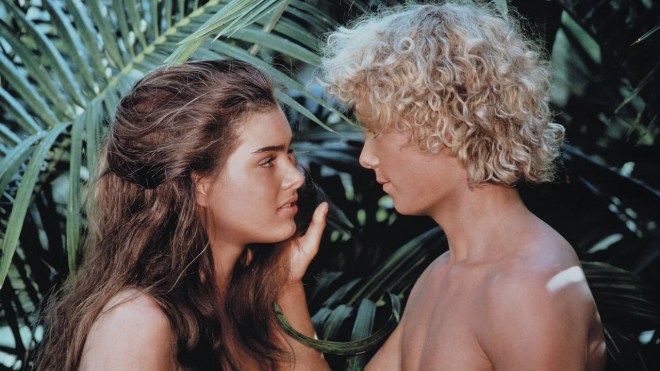
The original poster of the film expresses Kleiser’s main vision quite clearly. In large bold writing, it professes ‘A story of natural love’. Nominated for best cinematography at the 1981 Academy Awards, the island is shown in gorgeously saturated wide shots, the warmth emanating through the screen and complimented by the tanned and toned bodies of Atkins and Shields. The island is conveniently abundant with all they need, with no stress placed on their survival, the focus instead placed on how they grow and develop, physically, but also emotionally.
This lends to it being an automatically fascinating story. It is curious to imagine placing two children on an island with a basic understanding of the world and see how they would grow. It is especially enjoyable to imagine this as a beautiful, natural thing – whether realistic or not. One would hope they grow up free, expressive. And this is what Kleiser does. He displays them like he displays the island – romantically, emphasising their beauty. Even on the poster, the two are compared – ‘When their love happens, it is as natural as the sea, and as powerful.’ They live what seems to be a pipe dream in the modern ag: an ability to completely escape society. Movies, especially in Hollywood, are designed as escapism. It is pleasurable to place yourself in their shoes, imagining you can escape the constraints of society. But telling a story like this within a visual medium is going to bring problems with it.
Brooke Shields was 14 at the time of filming, Atkins was 18. In lieu of displaying ‘natural love’, Kleiser seems unafraid to exploit these young actors and their bodies. A lot of this genuine development of the children’s minds is dismissed in favour of filthy jokes, which make up the majority of the film’s humour. They don’t understand modesty, therefore are not afraid to sexually embarrass one another. These jokes are made under the guise of their own innocence, but that seems like an excuse to allow viewers to laugh at the expense of exploited and sexualised children. The film in many ways tells a beautiful story of two teenagers learning about themselves, but unfortunately is also unable to be completely separated from its director’s vision of sexualising children under the guise of a ‘natural love’, which makes for a frustrating watch.
 reeltalk0.movie.blog