Written by Michael Maxwell, Edited by Kleidi Likola
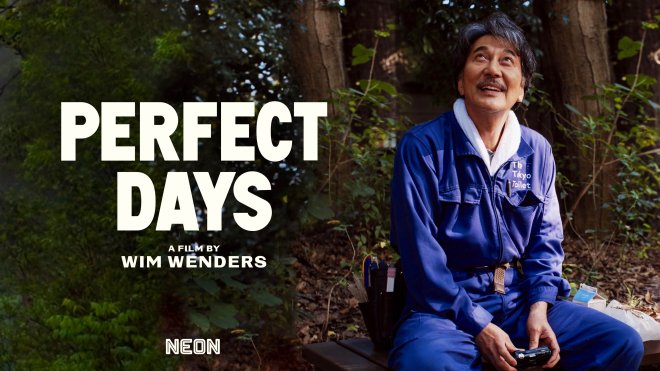
Perfect Days is the most recent addition to Wim Wenders’ exceptional filmography, a lesson in experiencing life in all its highs and lows, and an existential addition to the tradition of slow cinema.
My evaluation and discussion of this film will be structured in this way: I will first espouse the context of the film’s inception and production, contribute my analysis and thoughts to the discourse, and then conclude with some final additions and an analysis of its ending.
Directed by Wim Wenders, from a script co-written by Wenders and Takuma Takasaki, Perfect Days follows the daily life of a Shibuya-based toilet-cleaner played by Kōji Yakusho. Film students might recognise him as the man in white in Tampopo, a film we study in first year! Kōji Yakusho went on to receive the award for Best Actor at the Cannes Film Festival in 2023; the film itself received the Ecumenical Prize. It is the first Japanese-language film directed by a non-Japanese director to be submitted for Best International Feature at the Academy Awards. In an interview with Sean O’Hagan for The Observer, veteran director Wim Wenders noted that his 23rd film was produced swiftly, with a shooting period of 17 days and a very low budget. Luckily the original sponsors of the short film focusing on the Tokyo Toilet Project were enthusiastic about it becoming a fictional, feature-length film, allowing Wenders and co-writer Takasaki complete creative control.
The now feature-length film was originally intended to be a short film about the Tokyo Toilet Project. This project, implemented by the Nippon Foundation, involved redesigning 17 toilets in Shibuya by 16 designers from around the world as part of a scheme to change public perception of (public) toilets. Much of the film’s runtime focuses on these newly redesigned bathrooms, using incredibly intimate camera angles to detail the labour undertaken in maintaining their cleanliness. Kōji Yakusho spent two days training under professional cleaners to prepare for this role, which sheds light on a normally hidden and stigmatised part of daily life: the acts of cleaning and using the toilet.
Associated with uncleanliness, it is no surprise that these toilets were avoided and seldom used before the redesign. A survey conducted by Nippon foundation discovered that following the film’s release, usage of the 17 facilities by women are on the rise. Compared to before their renovation, use of the Hatagaya and Nishisandō Public Toilets have increased sevenfold and fivefold, respectively. Satisfaction with the facilities among users has also swelled from 44% to nearly 90%, while the number of people voicing aversion to public toilets shrank from some 30% to a mere 3%. The survey also saw a significant drop in respondents indifferent to public toilets, which decreased from around 30% to 8%. It is evident from these statistics that the legacy of Perfect Days has had a specific effect on Shibuya and its people in a way few films have. These toilets can be used by anyone, and due to their redesign and novelty, have facilitated a growing interest in sanitation and spending on public conveniences. These toilets not only serve as bathrooms but also as landmarks of a modern Tokyo, attracting increased tourism to the area and delighting many in the ingenious designs of each one. Following the film’s success, new landmarks in the form of these toilets have been added to Tokyo’s national and international perception. In changing out Mount Fuji, a staple ‘character’ of many Tokyo-based films, in favour of these new landmarks, Wenders manages to provide a differing non-fetishistic view of Tokyo.
Hirayama’s name is a direct nod to the work of renowned Japanese director Yasujirō Ozu, as it is the name of a recurring character in his films. Roger Ebert notes that Ozu resisted technological advancements in film, such as never shooting in widescreen, and resisting sound and colour in film until they were already popularised. In many ways a similarity can be drawn between Ozu and Hirayama’s insistence on not adapting to modern technologies, like Hirayama relying on cassettes, old novels, and an outdated phone for his daily life. Ebert also refers to something known as a ‘tatami shot’ that was frequently employed by Ozu who later in his career moved the camera less and less. Ebert describes it thusly, ‘[Ozu] usually filmed from a low point of view, roughly the eye level of a person seated on a tatami mat, shot each scene as one unbroken take, and eliminated all wipes, fades and dissolves.’ What is this, if not a description of the recurring shot of Hirayama setting up and putting away his tatami mat every day? The camera barely moves in many scenes of the film, allowing us to take in the mise-en-scène and experience his actions in a natural, slow manner. Such extended takes slow down the narrative, allowing us to be like Hirayama and enjoy the small moments, each equal to any other instant in his daily life. It is worth noting here that the original title of the film was “Komorebi”: a Japanese word meaning “sunlight leaking through the trees”. Indeed, we experience much of this through Hirayama’s photography and the enigmatic shadows of his dreams. Komorebi also refers to the act of experiencing life in its entirety through maintaining a sense of presentness. Each moment is equal to another, equally significant. Hirayama may have a troubled past unbeknownst to us, however no one would claim that he does not exhibit this philosophy of Komorebi.
Regarding Hirayama’s temperament and life philosophy, his sparse dialogue gives the audience little to understand him; however, through the truly evocative performance of Yakusho, one can begin to appreciate and may even relate to the character of Hirayama. Perfect Days gives a modern-day answer to the isolation of capitalism through a utilisation of the Myth of Sisyphus as understood by Camus. Maybe like with Sisyphus, we must imagine that Hirayama is happy in his somewhat monotonous routine. Perhaps the answer to the difficulty of uniformity is to embrace the interruptions to routine, and to enjoy each aspect of every moment. Wenders acknowledges that many of his earlier films stem from a desire for identification, in finding a way to live in a lonely world. For him, Hirayama is a character who presents ‘a perfect example of how to live’. Working in an industry which is so commonly disregarded, one may expect Hirayama to despair at the lack of respect he receives for his hard labour. Yet it is the small moments, such as the game of noughts and crosses that he plays with a stranger, and the small wave he shares with the child he reunited with his mother, that make his work worth it. As much as Hirayama may act reserved, he loves life, and his line of work is in the business of people.
In many ways, Hirayama can be characterised by his desire to hold on to the past. He remains young through his interaction with new life and new experiences while retaining memories from his youth, such as an incredible track-list compromising of Lou Reed, Nina Simone, Sachiko Kanenobu, The Velvet Underground, and so on. Save for 2 songs, the entire soundtrack was produced between the mid-1960s to the mid-1970s. This reflects Hirayama’s previous life, one we can infer was full of rebellion and tumult both through his music sense and his conversation with his seemingly wealthy and semi-estranged family. Hirayama is surprised at the discovery of “retro” media’s newfound popularity and value among the young generation. He shares his hobby of listening to cassettes with many of the young people he meets, with Aya feeling a special connection to “Redondo Beach” by Patti Smith. Hirayama’s ‘antiquated’ hobby is now recontextualised as a passion that can be shared across generations, allowing for the old (Hirayama) to connect with the new (Takashi, Niko and Aya).
A Varsity article, titled “Wim Wenders on Why Hirayama, the Tokyo Restroom Cleaner in ‘Perfect Days,’ Matters: ‘There Are No Nobodies’” by Leo Barraclough, noted some similarities between the film Groundhog Day and Perfect Days, but each similarity has a clear distinction to the earlier film. In both, there is a repetitive nature to the character’s lives, however Hirayama is seemingly content with his routine, finding routine changes strange and distressing at times. Both protagonists wake up in the same way, however in contrast to an alarm clock, Hirayama wakes up to a road sweeper resulting in a gentler wakening following a night of reading. His unconstricting routine is one that allows for comfort with interruptions which bring all kinds of emotion to Hirayama. Hirayama is a lesson in how to live, he acts as if every day is the first, not thinking about the past or future, simply engaging in his craft which here is the art of diligently cleaning toilets. Hirayama does so with a sense of nobility, unfocused on the goal but rather the journey of his life and labour, relating to his stance on life in general. In contrast, Groundhog Day focuses on breaking out of a cycle rather than relishing the everyday as Hirayama does with all its quirks and subtleties. Even in such a simple routine as Hirayama’s, life is full of interruptions: coworkers, family, handwritten notes. He may grumble at his changed routine, but Hirayama embraces each change with an eventual delight, treating each experience as an adventure.
Even as Dominic Hayes notes in his article for Mancunion that the film highlights the isolating loneliness of Modern Tokyo life through its use of cold colours (the blue van, grey roads and dreams, the white architecture of Tokyo etc.), Hirayama is an advocate for the forming of personal relationships in a depersonalising capitalist metropolis. He drinks and smokes (with humorous difficulty!) with a stranger, helps a child find his mother, and cycles with his niece, allowing her to take part in his routine and daily life. This is not to say that the film does not depict the isolating nature of modern life, but rather that Hirayama presents a solution. I would, however, be remiss if I did not acknowledge Hirayama’s decision to send his niece back to his sister. This rejection of personal and intimate relationships is integral to Hirayama as a person. He is, like anyone, flawed and sacrifices his relationships with others in favour of his routine-led life. Every day is the same save for a few interruptions; it inevitably begins and ends in the same way for his own sake. He promises that his niece can visit him, but his later tears and the final scene begs the question of whether being alone is the same as feeling lonely, and whether the simple life is worth the abandonment of long-lasting emotional connections. Is life’s journey really just a span of short meetings consisting of the collision between the worlds of people with no enduring connection? At the end of the film, Hirayama is able to retain his way of life, but his tears and anguish serve to represent the sacrifices and pain he has suffered in attaining the life he has now.
Furthermore, the motif of old and new is heavily present in this film. Hirayama’s tree friend is contrasted with the new Tokyo Skytree. Hirayama himself is an ageing man in an old profession, yet the areas he cleans are modern. He sleeps on a tatami, which is going out of fashion in Japan, now being replaced by the Western-style bed frame and mattress. Hirayama listens to music from his youth on cassettes, takes photographs on an old camera, but on the other hand collects new saplings from the local shrine to care for in his home. These contradictions of old and new constitute Hirayama’s person and by association Tokyo and Japan itself. Tokyo is a city of contradiction: old and new coexisting, intermingling in the same space. Hirayama’s short exchange with a stranger about time’s effect on memory can be taken negatively, where the old will be forgotten, however this is contrasted with Hirayama’s surprise that cassettes are now back in fashion. Not all is lost in the Tokyo of Perfect Days. Modern capitalist society may encroach on one’s individuality, modernity’s storm forcing ahead, unthinking of the debris left in its wake, but new life in the physical form of these saplings, the microcosms of joy, sadness, calm, and chaos which characterise Hirayama’s interrupted routine are what make life worth living in such a world.
The popularised fetishistic mode of viewing Tokyo is contrasted in this film with a seemingly more real and down-to-earth lived world of Shibuya for the average working citizen (Hirayama). We as the audience are barely made aware of Tokyo’s famously boisterous nightlife. As previously mentioned, we only see Mt. Fuji once in the form of an art piece. Instead, the Tokyo Skytree is the landmark heavily linked to the tree that Hirayama calls his friend and takes pictures of presumably every day. In a similar vein to some New Wave directors, the film takes place in a major, usually capital city, and follows the struggles of a singular protagonist, rejecting a reliance on easily recognisable landmarks such as Mt. Fuji for Tokyo, or the Eiffel Tower for Paris in favour of new landmarks or ones better known to the city citizens. In this sense, one could describe Perfect Days as a love-letter to the ‘real’ Tokyo and specifically Shibuya, free from the fetishistic and touristic view that is commonly purported in media of nightclubs, sprawling screens, and debauchery.
It would be wrong to write about this film without commenting on its incredible ending. Hirayama’s morning commute, an event we have witnessed from many different angles, is repeated; however, in the last sequence, the audience is treated to a close-up of Hirayama’s face. Beginning with a smile, as the powerful voice of Nina Simone singing “Feeling Good” gains volume in the background, Yakusho gives an incredible performance of Hirayama’s previously sparse emotions. The music in the film is integral to understanding Hirayama’s mood at any one time, relating also to the time of day and part of the film it corresponds to. Many of their names relate to times of day, and to conclude the film on “Feeling Good” provides the audience with the answer to how Hirayama continues to live such a life. For Hirayama, every new dawn, and every new day is truly a new life for him. The routine does not bore him because every day is unique, and surely if Hirayama can find his life enjoyable, we can learn from him to do the same. A perfect day is not one that is only happy; a perfect day is a matter of perspective. A perfect day is the one lived. On watching this film, Hirayama appears as a mascot of humanity, a champion for a simpler style of living. In this scene we witness the contortions of his facial expressions, oscillating between joy, acceptance, and anguish, as he experiences all the emotions of life in all their unrestrained pain and beauty. Hirayama is not ‘happy’, nor is he ‘unhappy’. Life is too complex for such identification. He is alive and that is a beautiful thing.
 reeltalk0.movie.blog