Written by Liberty Boyd-White
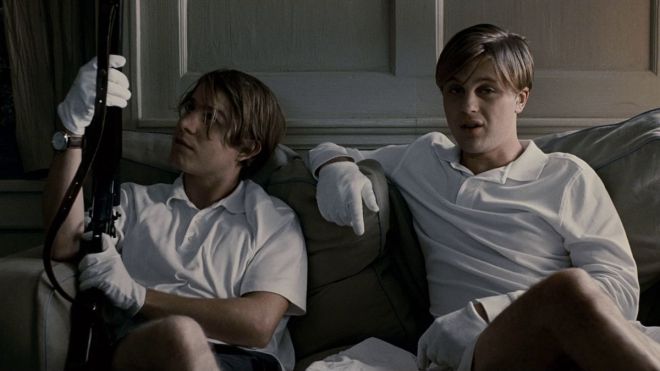
To remain a passive spectator for the entirety of Michael Haneke’s Funny Games (2007) is arguably a near-impossible feat. In its first portion, that invites an unmistakably benign viewing of the bourgeoise family en-route to their private lake house, it is easy to remain dismissive of their upper-class affairs. At least, it would be if not for the introduction’s simultaneous destruction of the image, as the thrashing tones and manipulated screams of experimental band ‘Naked City’ rip across the image of the family. Immediately from the offset; all is not as it seems. From the muted inside of the family home in which the wife (Naomi Watts) unpacks provisions to the lakeside and the family boat that preoccupies father (Tim Roth) and son (Devon Gearheart) – the life of the Farbers appears idyllic. Although, inspired by the recent piercing screams, we may eagerly await the appearance of cracks in this façade. A wait cut short by the appearance of ‘Peter’ (Brady Corbet) and his neighbourly request for ‘four eggs’ that are near-immediately smashed by the stranger’s fumbling. Another request follows, so do another four broken eggs. Jostled by the barking of ‘Lucky’ that soundtracks the invasion of a second stranger ‘Paul’ (Michael Pitt) into the home, the boundaries of polite hospitality ultimately snap at Peter’s third request.
As the social tension between manners and the psychic unease that accompanies the strangers’ entrance begins to stoke a physical reaction from the viewer – one of unease, a perhaps familiar awkwardness that consumes the body. A sensation that, as the family reunites for the social trial of Mrs. Farber’s ‘unfriendliness’, begins to morph into something far uglier: fear. A sensation crystalised as the precise downward swing of a golf club connects with the Farber patriarch’s leg, leaving him immobilised and writhing and the family at the mercy of two strangers. The immediate shift from verbal to physical confrontation having prompted a consuming panic that will come to define one of the most unique viewing experiences of horror cinema, one made up of a series of perverse and violent games, explicitly put on for your viewing pleasure. Those on the search for ‘cracks’ are now bombarded by the flood of assaults put on against the innocent Farbers. Why did you wish for violence? Now Mr & Mrs are bound, beaten and stripped. Why did you wish for a break in the mundane? Now the youngest Farber is chased, suffocated and tortured. Even the death of a protagonist cannot provide the ‘relief’ suggested by an end to the violence, to think your desires as spectator still hold power in the ‘rules’ of said game is incorrect. To choose to watch Funny Games is to be made complicit in its horrors. To be shown violence, not as the product of sensationalism, but of our own twisted desires. As ultimately, we remain fearful not of the ‘villains’ for their actions, but of ourselves for demanding them.
 reeltalk0.movie.blog