Written by Rowan Abbott
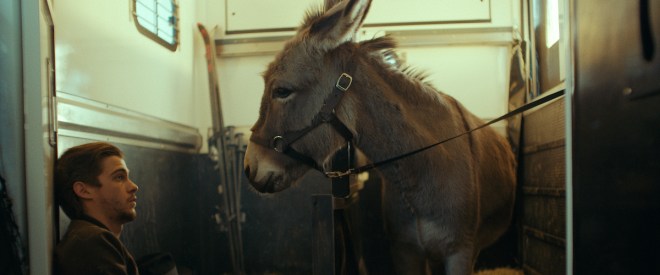
EO (2022, Jerzy Skilomowski) is a sweeping tale of a circus donkey set free into rural Poland, a place that can’t seem to decide what purpose a donkey still has for humans. In a state of limbo between free-roaming in the Polish wilderness, and being possessed by various human handlers, the titular donkey’s journey makes for an exceedingly rare form of animal representation in cinema. Unlike the majority of fiction films with animal protagonists, EO is not anthropomorphised; the audience is forced to relate to him as a donkey, not as an animal surrogate for a human story. This means the film takes on a wholly unique form, using the full subjectivity of the cinema to place the audience directly in the shoes – or hooves – of a donkey; challenging the audiences views on the nature of the human/animal divide.
The picaresque narrative never settles on one place for long, each vignette happens with the immediacy of a donkey’s life perspective; a creature without the same capacity for rationality that humans possess, including the ability to plan ahead, or relate current events back to previous ones. There are two brief exceptions to this, when the film flashes back to EO’s time at the circus with his handler Kassandra, seeming to imply that he yearns for the human that raised him. Beyond these brief seconds, the film stays in perpetual forward motion, emulating the lack of attachment EO is able to form with any of the places he stays. EO’s brief encounters with humans paint a visceral image of our species, as each person understands and treats him differently. Having been placed firmly in EO’s perspective of the world around him, these human interactions reveal just how dismissive humanity is of the animal as a being of moral consideration. The film’s challenge to its audience – to truly consider their relationship with animals – seems to be understood most by EO’s final human encounter, a priest named Vito, who talks to EO as if talking to a human companion. When looking into EO’s eyes, he seems to truly question his relationship with animals, which compels him to confesses his guilt overeating meat in the past – including donkey meat.
Similarly to the priest, the audience is consistently made to look into EO’s eyes, made to consider what it is he sees, and how he sees it. Without the crutch of anthropomorphism, the film must employ an innovative form to keep the audience aligned with EO. The most overt is the point of view shot, with shallow focus and a low angle camera, the film often dives directly into the world as EO sees it, contrasting the traditional filmmaking style used for the human drama of the film, with the effect of making the audience realise just how different a donkey’s view of the world is. In the film’s most curious stylistic choice, the camera frequently veers off into near-abstract sequences of purely sensorial filmmaking. A red tinted frame and disembodied camera characterise these sequences. Though their explicit meaning is elusive, they play a vital role in decentralising the human perspective that the audience will be all too familiar with. By forcing the spectator into a truly unknown perspective, these sequences act as a kind of perspective palette cleanser, making the rest of the film feel more familiar, making the audience feel at home in the perspective of a donkey.
 reeltalk0.movie.blog