
Written by Anastasia Gandzha, Chao-yuan Yang, and Finn Chadwick, Edited by Alejandra Benavides Valcarcel
Film and Television Studies students share their thoughts on some of the films shown in the Special category at the Berlin International Film Festival.
At Aterroes & Rosa Parks (Nicolas Philibert, 2024)

“Regurgitation of Nothing.”
An extension of last year’s Golden Bear-winning On The Adamant (2023), the documentary continues to carry director Nicolas Philibert’s ambition to voice concerns related to psychiatric patients and their caregivers in France. This time, rather than an unusual floating care centre on the Seine, we follow the camera into a more commonplace hospital. The patients there are stricken by mental illness and, through the lens of the camera, the audience will very much feel their suffocation.
But should appeals to humanism outweigh creativity and aesthetics in cinema, especially in documentaries? Whilst we must give props to Philibert’s empathetic attempt, there seems no clear reason to make a sequel with nothing new to say. Throughout the draining viewing, we are bombarded with over-the-shoulder shots, with no camera movements, with nothing. It feels almost like the filmmaker ran out of cinematic ideas to take a fresh look at what has been repeated ad nauseam. The interviewees complain about their job hunting, their lives, and their meaningless behaviours. There are times when we are guided to a larger room where multiple patients are expected to do something, but the tableaux of nothing again shatters our hopes, all the way giving a sense of nihilism.
I cannot deny Philibert’s painstaking effort to enter a place that most people tend to shy away from. But let’s agree to disagree on humanism by default, as there is a plethora of documentaries on similar subjects that have done much better than At Averroes & Rosa Parks (2024) without losing the essence of cinematic techniques; say, Titicut Follies (1967), Inmates (2017), and On The Adamant, of course.
2.5/5 Chao-yuan Yang
Cuckoo (Tilman Singer, 2024)
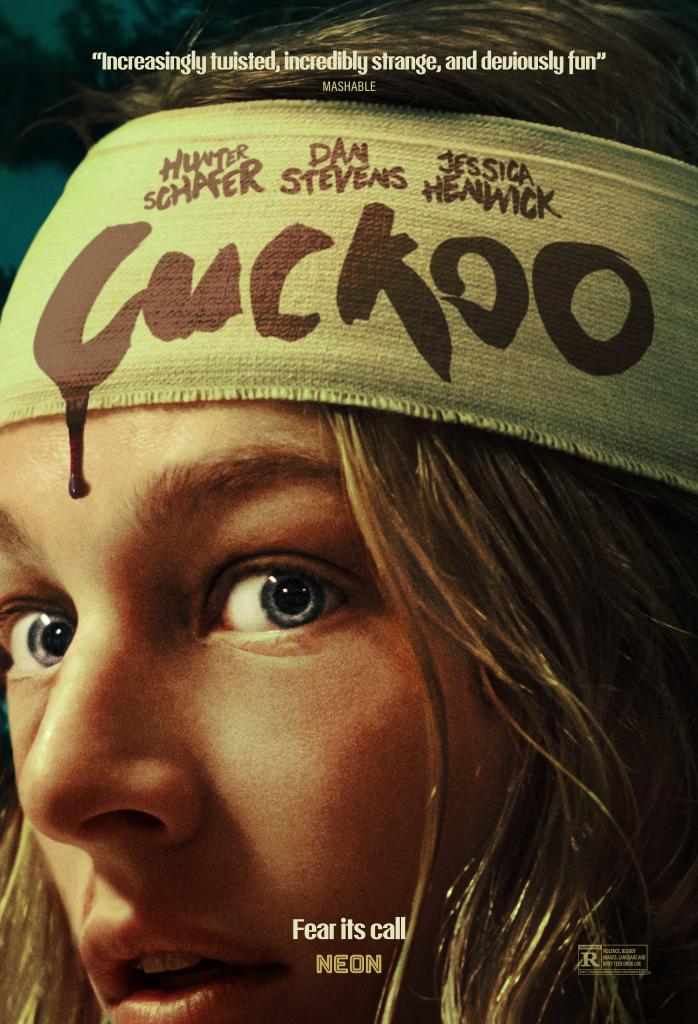
“Unexpectedly Thrilling and Empowering.”
A bit baffling at the beginning, Cuckoo (2024) uses especially subjective shots and effects that show the psychological state of the main character. But all the things are difficult before they are easy. It becomes clearer that the bizarre cinematic choices, particularly the use of sound, have to do with the revelation of and resolution to the real issue with the characters.
The film unsettles the viewer, very much relying on sound, to the degree that it feels like a B-movie at times. I do not want to spoil, but just a heads-up, be prepared for some character’s screeching, jump-scare moment. Despite this, the concept of the film is more than intriguing. It is a nice attempt at body horror—which is interesting alongside the reading of Kristeva’s theory of abjection. Beyond the bodily excretions lies more. The film is a Frankenstein of feminism, coming-of-age, and pure fun to uncomfortably enjoy.
4/5 Chao-yuan Yang
Hako Otoko (Gakuryu Ishii, 2024)
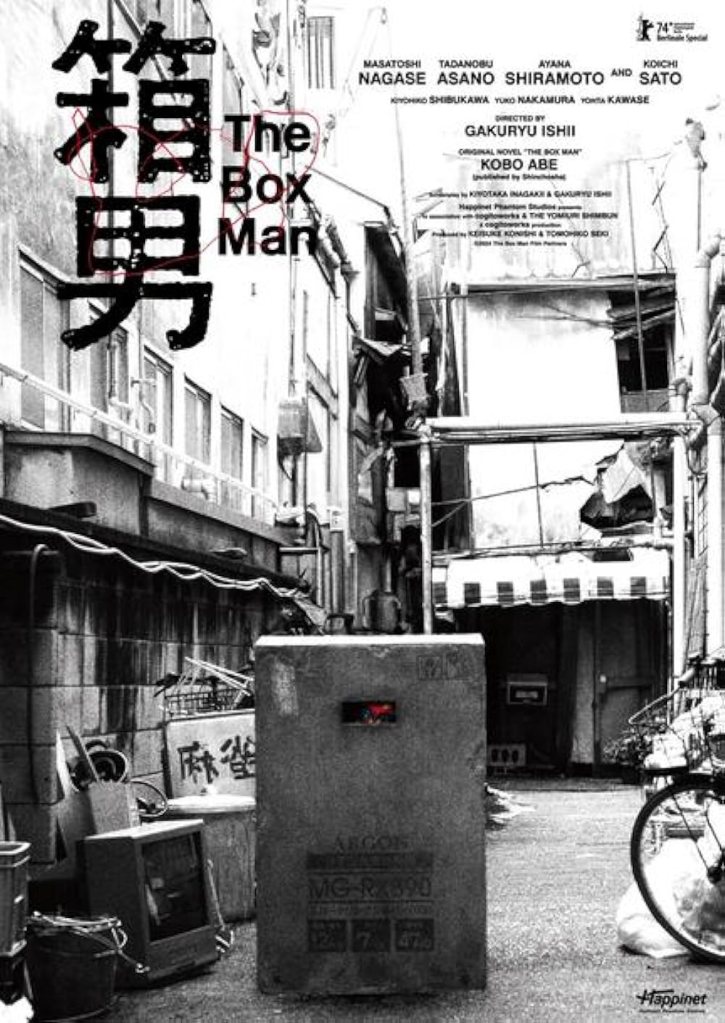
“Restricted and playful as the essence of Japanese society.”
If you know a thing or two about Japanese literature, you know Kobo Abe’s The Box Man is not a book for everyone. So is Gakuryu Ishii’s on-screen adaptation of the novel. With a cast of no more than five actors and a limited space, it is suitable also for a stage adaptation. The core of the restricted plots and locale points to the individual reflection on an existential level.
Ishii is not an emerging filmmaker. Quite the opposite, although keeping a low profile, the tight-budget veteran excels at making the most of what people expect from films in the Japanese context—say, dealing with subjects such as the aftermath of WWII, men’s struggles, and eroticism and perversion. The erotic sequence is the highlight of the film that very much embodies the essence of a Japanese setting. The actor and actress playfully interpret perversion without making it look like pornography.
3/5 Chao-yuan Yang
“Literally ‘outside of the box’ experience.”
It was quite an experience…that I really want to forget. The premise of the film had powerful potential, and I was surprised how Ishii just destroyed it completely. Maybe it is the fact that I am not a fan of such eclectic and messy filmmaking – which toes the line between trashy kitsch and Obayashi’s aesthetic of exaggeration – or chaotic plot, but this film was not what I expected and while the box man was fighting his identity, I was fighting the urge to leave the screening room.
1/5 Anastasia Gandzha
Sasquatch Sunset (David and Nathan Zellner, 2024)
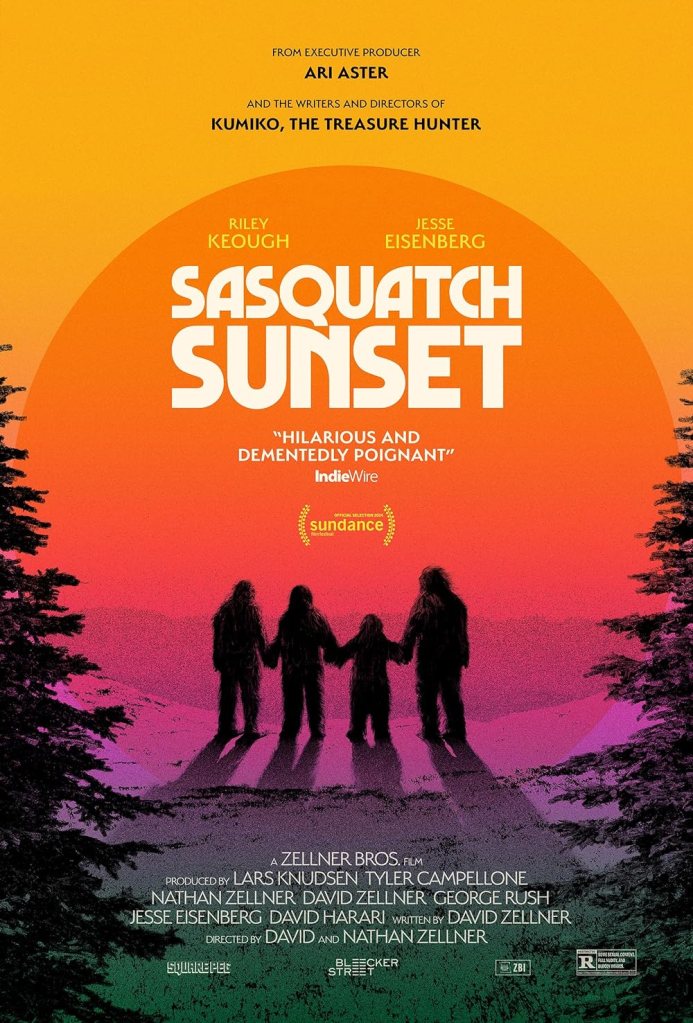
“Uncomfortable rather than touching or funny.”
No dialogue. Nearly no sign of civilisation. It’s just the forest and a family of four Sasquatches. Although it presents itself as something poetic, it is in fact the opposite. This is not necessarily a bad thing, but the overreliance on potty humour did leave me wanting something more, even if I did laugh a lot. The film allows itself to talk about the family unit as something born out of nature but explores this in a way which leaves the viewer feeling uncomfortable rather than touched. This is of course a part of the black comedy style that the two brother directors adopt, having also made The Curse with Benny Safdie and Nathan Fielder.
The cinematography is something to behold, long wides of the natural world seemingly unfolding before our eyes. However, it is not all reality, for we have Jesse Eisenberg and Riley Keough in their sasquatch costumes giving a more than convincing performance as these mysterious animals. All in all, it is a good time. Is it profound? I don’t think so. Is it funny? If you have the right sense of humour. Have I thought about it since? No, I have not. Ultimately, I am disappointed by the lack of depth.
3/5 Finn Chadwick
 reeltalk0.movie.blog