Written by David Noik, Edited by Nikki Wilks
In this blog post I intend to give everyone a peek into the Jewish community’s view on You People (Barris, 2023) and articulate comprehensively why these feelings are utterly justified due to the film’s inherent antisemitism, and the ignorant washing away of rich Jewish culture. For better understanding of this blog post I can recommend reading or watching David Baddiel’s book and documentary, Jews Don’t Count (to give a startup inside view on the ignorance of antisemitism as a profound issue). The documentary features the voices of many Jewish celebrities and their opinions on rising antisemitism, along with being executively produced by Louis Theroux.
You People is a Netflix Original ‘comedy’ which revolves around Ezra (Jonah Hill) and Amira’s (Lauren London) relationship as their families clash with each other over cultural differences. Along with the main couple, Ezra’s family consists of Shelley (Julia-Louis Dreyfus) as the main Jewish ‘antagonist’, and Amira’s family has Akbar (Eddie Murphy) as the main Black ‘antagonist’. On paper, and perhaps if this movie was created in the Apatow renaissance of comedy, this film contains all the ingredients for an iconic and hilarious movie capable of battling other modern comedies like Superbad (Apatow, 2007), The Hangover (Phillips, 2009) and Anchorman: The Legend of Ron Burgundy (McKay, 2004). Despite the cast containing three absolute icons of comedy (not you Lauren London) the film flops in both comedy and moral message, and somehow has the audacity to make Eddie Murphy a bore.
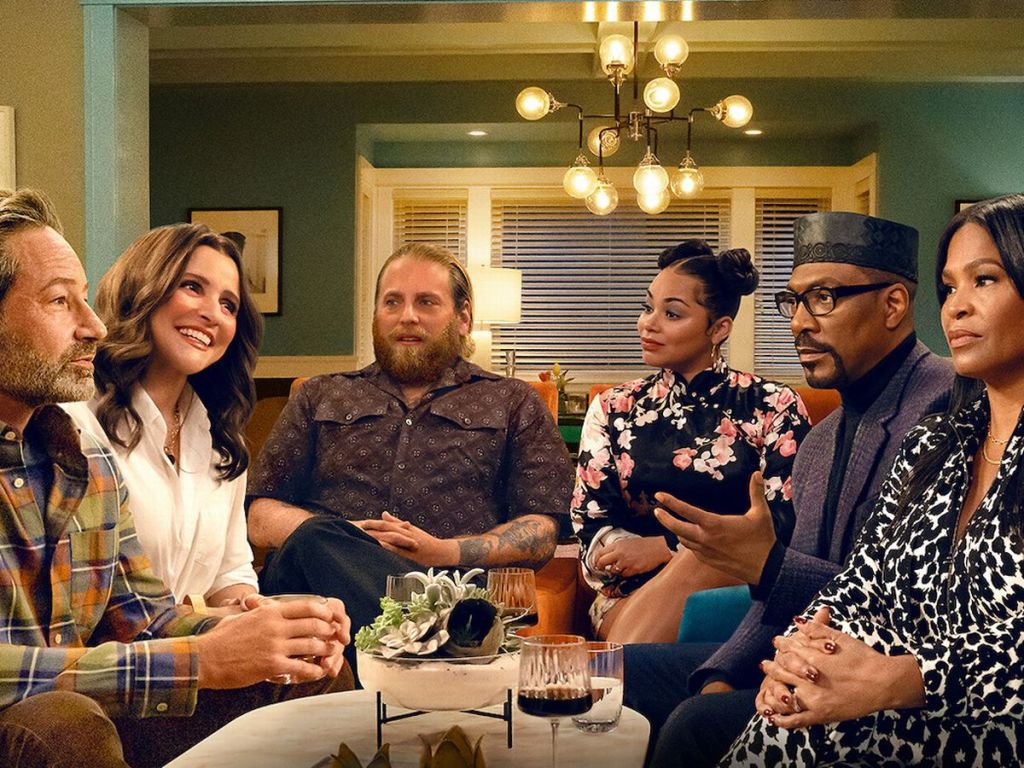
My first issue with You People is how it confidently and unapologetically erases rich Jewish culture and turns the Jewish family into a wealthy, American household with timid hints of Judaism sprinkled throughout its characters. The two parent characters’ dialogue is void of any Hebrew or Yiddish slang which is abnormal for the traditional Jewish dialect. There is not a Mezuzah, candlesticks or yarmulke in sight during the dinner scene which takes place in their family home. Foods embedded in Ashkenazi culture like gefulte fish, challah, chopped liver, kibbel, kugel, bagels, bubke, and smoked salmon are absent from this film which only further highlights the ignorance in writing for the film. Another recent dramatic-comedy about the Jewish household, Shiva Baby (Seligman, 2020) demonstrates these factors very well; the audience are not spoon-fed unwanted lore but instead background items such as smoked salmon, hummus and Mezuzahs allow the Jewish audience to feel satisfied with the representation while non-Jews are none the wiser and do not feel pressured to endure the force-feeding of another culture. My critique of the family and household is not so much based on my offence, but rather I am merely irritated by the filmmakers’ ignorance, and noticeable lack of interest, of Judaism and instead it feels like a pointless label which lacks any form of depth or substance; the family is a typical white, spoilt American family labelled as Jewish.

Despite the paragraph above being lengthy, it is nowhere near my main issue with the film. My main issue with You People is that it seems to pride itself on wedging a gap between Black and Jewish cultures, which is cheaply, half-heartedly and nonsensically resolved at the end of the film. For starters, it feels like the writers, Jonah Hill and Kenya Barris, dug around in a bag for any controversial links possible between the two cultures. Both families are made to be incompetent with speaking to people outside their respective ethnic groups; this is untrue and frankly offensive and only helps to divide the two wonderful cultures rather than embracing and uniting. This movie does not even attempt to illustrate all the many joyful and positive similarities. One example, which instantly comes to mind is when Eddie Murphy’s character mentions that his Kufi was given to him by his hero, Louis Farrakhan; an intensely controversial figure who prides himself with antisemitism. As a brief disclaimer, I full-heartedly believe in separating the artist from their art, so I am still a passionate fan of other keen antisemites like Walt Disney, Roald Dahl, and Malcolm X amongst others. However, the issue with Farrakhan is that his art is indeed antisemitism. He has written countless articles, speeches and books about the Jew Problem even requesting to not be called an antisemite but instead “anti-termite!”. From this brief summary of the Farrakhan, you can clearly see how roping him into the conversation was purely to create hatred and division between both cultures. I can guarantee that if the film was written a year later, then Kanye West would also be amid this conversation. Essentially, I cannot understand why the writers would want to divide both cultural groups with such force; bringing up figures such as Maya Rudolph, Drake, Rashida Jones or even Doja Cat could’ve provided human bridges between both cultures. The movie should’ve celebrated the differences and similarities between both cultures rather than being pessimistic, discouraging and dividing.

In conclusion, along with the film’s borderline sci-fi trickery that makes Jonah Hill really good at basketball for no reason in particular, You People manages to make me avidly dislike a cast containing legendary comedic actors: Eddie Murphy, Julia Louis-Dreyfus and Jonah Hill. The humour is cheap and is a mere whisper of the golden age of Apatow-esqe comedies of the 2000s. Jonah Hill and Lauren London’s characters have only slightly more chemistry than my grandpa and Louis Farrakhan (I am being half-serious as the kissing scenes were created using CGI). The film is a perfect example of David Baddiel’s Jews Don’t Count argument, which is clear as day evident when the Jewish Julia apologises to Eddie, but not vice-versa despite Eddie committing worse acts of antagonism. For anyone interested in films and television shows which accurately and joyfully represent modern Judaism, turn to Shiva Baby, The Meyerowitz Stories, Uncut Gems, Curb Your Enthusiasm, Friday Night Dinner and more recently Steven Spielberg’s The Fabelmans.
 reeltalk0.movie.blog