Written by Zak Robinson, Edited by Abigail Aldrich
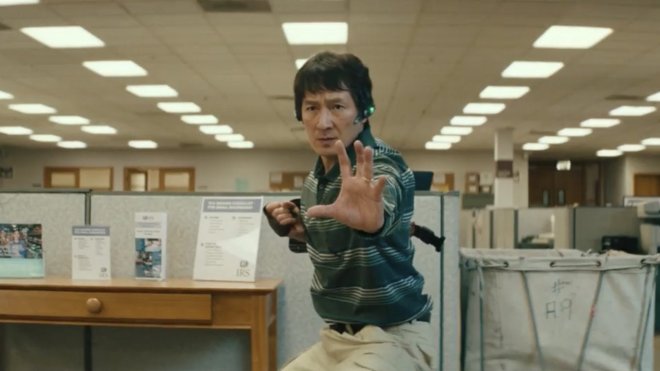
Awards season 2023 is winding down, and there is perhaps no star more discussed than actor Ke Huy Quan. After an almost 30-year hiatus from Hollywood, Quan played Waymond Wang in the Daniels’ Everything Everywhere All at Once. Despite so long away from the silver screen, Quan took home an Oscar for Best Supporting Actor at this year’s academy awards.
In 1985, Indiana Jones and the Temple of Doom released to wide audience acclaim. Co-starring alongside Harrison Ford was Ke Huy Quan, a 12-year-old child actor who was auditioned at his elementary school. He was a hit with audiences and went on to star as ‘Data’ in the 1985 cult classic The Goonies. Quan seemingly had a fruitful career in stardom ahead of him. In a 1984 interview, a young Quan remarked that he felt very fortunate: ‘I’m number seven in my family, that’s a lucky number.’ However, his luck would apparently soon run out, with The Goonies being the last Hollywood film he would appear in for 35 years.
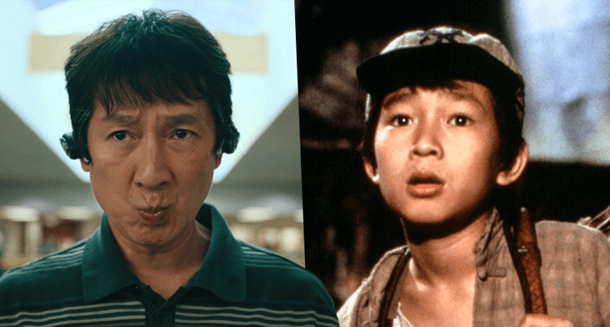
This isn’t to say that Quan had no work in the following years, however, appearing in a handful of TV shows and working behind the camera as a stunt coordinator on X-Men. As to why he stayed behind the camera, he remarked in an interview with the Hollywood Reporter in 2023, ‘Hollywood didn’t want me’. Quan’s personal experience is emblematic of a wider issue of representation in Hollywood as a whole.
In a study of Asian and Pacific Islander (API) representation in Hollywood from 2009-2017, it was found that only 5.9% of characters in films were API. Furthermore only 44 films had API lead actors. Fourteen of these were Dwayne Johnson. 59% of these performers also only had one role, all others (besides Keanu Reeves, Dwayne Johnson and John Cho) having only two. Over the span of 12 years, it is beyond shocking how few roles were afforded to these actors and actresses. One can only imagine how many performers, just like Ke Huy Quan, were forced to give up their dream entirely.
Sometimes even Asian characters end up being played by white performers, such as Tilda Swinton as The Ancient One in Doctor Strange or Scarlett Johansson in Ghost in the Shell. This is not out of necessity, representing clear choices by Hollywood casting directors who pick who they perceive to be most likely to bring in audiences. Kevin Kwan, author of Crazy Rich Asians, revealed that whilst offering his book to different studios he was met with one pitch that suggested he make Constance Wu’s character white. He refused this, selling the rights to his book for only a dollar just so he could be involved in the film’s development. Eventually Crazy Rich Asians was released with an entirely Asian ensemble cast, being a critical and commercial success.
In many ways, the success of Crazy Rich Asians marked a turning point for Asian representation and recognition in Hollywood. For Ke Huy Quan, it was a moment of realisation that, as he said in an interview, ‘Hollywood has changed’. Suddenly the dream he had said goodbye to so long ago was becoming real again. Bong Joon Ho’s Parasite won best picture in 2019, the first Asian-directed film to win that category since the award’s inception. This pattern repeated in 2020 when Chloe Zhao took home a best picture for Nomadland. And ultimately, in 2022, both Michelle Yeoh and Ke Huy Quan made history in becoming the respective first Asian winners of the best actress and best supporting actor academy awards.
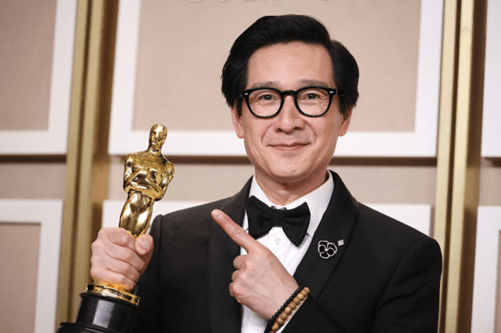
It seems the luck Quan mentioned in his 1984 interview had finally returned, launching him to Hollywood stardom. But to attribute his success to luck would be selling him short. His perseverance and, ultimately, his belief in his dream led to his success. In his emotional Oscar acceptance speech, Quan reminds audiences that ‘dreams are something you have to believe in,’ and whilst it remains to be seen if the academy recognition that Asian artists have received will translate into better representation, it may at least give aspiring Asian artists hope that their Hollywood dreams are worth believing in.
 reeltalk0.movie.blog