Edited and Formatted by Issy Smith
As a start to this academic year, we wanted to invite our editors and students to discuss our topic for this term: Raising Black Voices. From directors to writers to actors, we feel this topic is ever important and hope to move forwards this year and across the blog going forwards with a celebration of black art and filmmaking. To begin, we asked our editing team for recommendations and reviews and compiled an initial reflective dossier on what this topic can involve.
Liberty Boyd-White on I Am Not a Witch (dir. Rungano Nyoni, 2017)
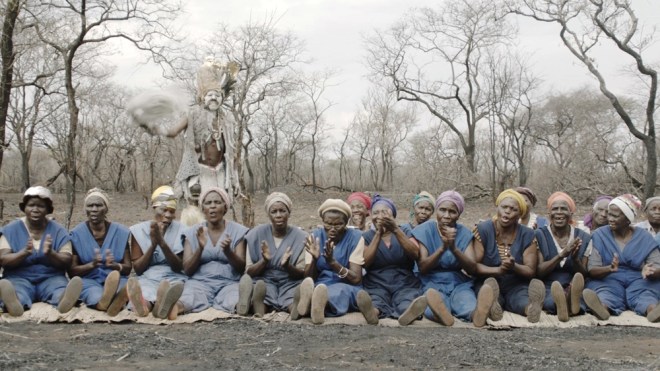
From the opening of her debut feature I Am Not a Witch, Rungano Nyoni provides a stark vision of life in Zambia. A tour bus rumbles down a rural dirt road, carrying a selection of tourists to their destination: native women, kneeling on the ground, tied to posts with white ribbon. These are the witches of the area, supposedly formidable enemies of the general public, tethered down by white ribbon for the viewing pleasure of white and black tourists.
Nyoni’s film centres around the lives of such women, basing her narrative on real accusations of Witchcraft and the government run ‘witch camps’, exploiting physical labour from those charged with the crime. The director translates these adult affairs through the eyes of a young girl, Shula, who is labelled a witch by society and subsequently exiled. Chained by the same white ribbon as the other women and told that should she ever cut it she’ll be cursed to transform into a goat, Shula is doomed to capitalist exploitation at the hands of her ‘government guardian’, Mr Banda. Deemed an ‘other’ by society, but paraded on daytime chat shows, Shula’s story embodies the tragic intersection of tradition and modernity with searing wit. One of the film’s key scenes, in this vein, comes from a clearly distressed Shula being forced into a selfie with an unapologetic white tourist.

The first-time performance from 9-year-old Maggie Mulubwa powers Ngoni’s work; its largely non-verbal nature pushing us to consider who Shula chooses to speak to and whether, in this situation, her words would truly have power. I Am Not a Witch makes something brilliant out of a dire social reality, mixing an excellent balance of the comedic and grim with dramatic visuals and strong sound choices to deliver a bizarre yet beautiful form of catharsis.
Mithun Muraleetharan on The Cinematic Albums of Kendrick Lamar
With the advent of streaming, chances of musical virality have gone up exponentially. In this age of instant gratification, the long-form art of album-sequencing has been overshadowed by the viral single. Rap is one of the genres that has fallen victim to this trend, with bloated albums- or rather glorified playlists- slowly becoming the norm. An example of this is Lil Baby’s recent It’s Only Me– a 20-song album arranged with no sense of narrative nor progression. Albums of this nature are made to be consumed as a sample plate, with the listener picking and choosing their favourite songs to add to their playlist. In contrast, iconic albums like Ready to Die by Notorious BIG—a semi-autobiography following the artist from birth to fictional suicide—and ATLiens by Outkast—wherein the duo build an overarching interstellar atmosphere—clearly exist as their own singular entity, with the whole greater than the sum of their parts.

However, there are still modern artists that maintain musical cohesiveness throughout an album. One of the most notable artists to do so is Kendrick Lamar. Although the creator of his fair share of viral hits, from ‘Swimming Pools’ to ‘Humble’, what has cemented Lamar’s status as one of the greatest to ever touch a mic are not individual songs but his albums. Each of his albums contain intricate lyricism that weaves narratives, motifs or thematic journeys that encompass the entire hour. His second album, Good Kid, MAAD City is not subtitled ‘A Short film by Kendrick Lamar’ for nothing, as the rapper documents a fateful day in Compton that shapes him from a wide-eyed teenager to a matured artist. This structure follows the most fundamental doctrine of all great hero’s journeys: change. Even in his landmark 2015 album To Pimp a Butterfly, he focuses on his journey from a self-centred rapper looking for material wealth into a philosophical individual aware of his history.
Lamar is intrinsically aware of his role as a storyteller, something evident from his consistent evocation of other mediums. To Pimp a Butterfly interweaves a poem through its disparate songs, to highlight the protagonist’s internal monologue. His recent emotionally vulnerable Mr Morale and the Big Steppers takes on the hallmarks of a stage play. Its two discs essentially play as two acts with the song We Cry Together making this theatricality explicit. By incorporating the tropes of other mediums that are more explicitly narrative, Lamar heightens his own albums’ sense of structure.
Kendrick Lamar’s albums are marvels of storytelling to be experienced as a whole. Some of Lamar’s contemporaries have created albums that walk the same conceptual footsteps, including Tyler the Creator’s Flower Boy, Dave’s Psychodrama, Ghetts’ Conflict of Interest, and JID’s recent Forever Story. These artists make albums with the intention of creating experiences, rather than 20 chances to go viral. In doing so, they eschew ideas of short-term virality in favour of building a long-term legacy, and, in doing so, carve their names under legends like Notorious BIG and Outkast.
Issy Smith on The Mark of Lilith (dir. Bruna Fionda, Polly Gladwin, Zach Mack-Nataf, 1986)
While the next decade would see attention to a black lesbian cinema spike as Watermelon Woman (dir. Cheryl Dunye, 1996) and Set It Off (dir. F. Gary Gray, 1996) dominated conversation, The Mark of Lilith, a 1986 student film, deserves to be returned to. Upon its redistribution and return to public view in the BFI’s Blu-ray collection Short Sharp Shocks – Vol. 2, the film is slowly becoming a cult favourite, with the (often on-the-nose) self-reflexive dialogue and unique stylisation elevating an already exciting premise to heights the low-budget student film can hardly sustain.
The film follows Zena, a black lesbian researcher whose focus on representations of monstrous women in horror intersects with her budding relationship to a bisexual vampire, Lilith. The emphasis on the monstrous is complicated by race: the white woman becomes the predator with the black woman as her prey, questioning established legacies of race in horror to examine tensions reminiscent of Jordan Peele’s later work in the genre.
The aesthetics of the film further explores these two characters as products of separate worlds. The avant-garde and hyper-stylised gothic fantasy seeps into the grounded reality of Zena’s life, as masked audiences line a cinema where she lectures on representation. Their white faces and emotionless smiles become a banner for the assumed audiences of horror cinema, while Zena’s performance is situated in stark contrast.

As a piece of black cinema, it’s an exciting but grounded work, while as a lesbian horror it’s expressive and aesthetically inventive. The two halves make for an unholy matrimony which begs to be examined and explored by audiences, an exciting achievement for the first and final credited work of the directors involved.
 reeltalk0.movie.blog