Edited by Anfisa Semenova
As the Autumn term draws to a close, our Reel Talk editorial team put together a list of films to keep you entertained over the holiday period (when you’re not writing your essays…) Any type of viewing you are in the mood for, we’ve got you covered with plenty of suggestions! Get yourself a cosy blanket, a cup of hot chocolate, and enjoy your well deserved break.
The Polar Express (2004) – Abigail Aldrich
“Sometimes seeing is believing, and sometimes the most real things in the world are the things we can’t see”
– Conductor, Polar Express

Nothing compares to the nostalgia and excitement felt when the Christmas season swings around once more and your favourite Christmas movie graces the screen. For many people, this film is The Polar Express (2004). Grossing over $314.1 million, the beloved film continues to be a family favourite eighteen years after its release, even influencing real-life Polar Express experiences around the UK. Whilst known for its festive and vibrant depictions of the North Pole, Father Christmas, and the train, or possibly for its slightly creepy motion-capture animation style… the film is packed with meaning for its audiences.
One of the most noticeable aspects of the hit film is the notion that actor Tom Hanks plays not just one, but six characters. Voicing Hero Boy, his Father, the Conductor, Father Christmas, Scrooge and the Hobo allows the film to suggest that the boy may grow up to be any one of them, depending on whether he chooses to continue to be cynical, or to believe. Each character works to depict his internal debate as to whether or not he should believe, with the Conductor and Father Christmas embodying belief, and the Hobo, Scrooge, and Father representing cynicism.
The Conductor and Hobo in particular act as foils and so reflect the two paths the boy may take, depending on whether or not he chooses to believe – something that possibly gives the film a darker tone as it seems to suggest that if the boy lets go of this childlike imagination, his future will be gloomy. He will become bitter and miserable, continuing to grow old till he passes – indicated through the ghost of the Hobo, as well as the dark colour palette associated with him. Meanwhile, associated with a more vibrant colour palette, the boy could lead a more joyful life like the Conductor if he chooses to believe.
The film therefore works to highlight the importance and power of believing, not just necessarily believing in Father Christmas, but the power of believing in yourself and your dreams, in removing self doubt and learning that “sometimes the most real things in the world are the things we can’t see”.
My Film-Watching New Year’s Resolutions – Diya Gill
As a film and television student at Warwick, whenever I talk about my course with others I’m always met with a line of questioning about what ‘classic’ or ‘iconic’ films I’ve actually seen. My answer is more often than not a shameful ‘no…’.
Pulp Fiction? Nope. Gone With the Wind? Nah. The Godfather? Yes, actually. The Silence of the Lambs? No.
However, I do want to change this next year. New year’s resolutions are typically about improving yourself or accomplishing goals, and although I do want to drink more water, I think it is also very important to have some fun goals for yourself. So, one of my new year resolutions (that I will hopefully continue post-January) is to watch a more diverse range of films, since what one may consider a ‘classic’ or ‘iconic’ film is completely subjective. This winter is as good a time as any to set these goals and I encourage you to do the same. The reason I chose to study film and television, much like most film and television students, is because I understand and appreciate the cultural importance of cinema, want to learn more about it and engage with others who want to do the same. Films are also a perfect form of escapism for when life or university becomes just a bit too much and a break is needed. Therefore, I want to watch more! Hopefully listing my film-watching new year’s resolutions will inspire you to create your own list of resolutions this winter to prepare for the new year, film-based or not, and perhaps even hold me accountable.
Without further ado, my film-watching new year resolutions are:
– Watch 3 Quentin Tarantino films that I’ve never seen before (Pulp Fiction finally stands a chance!)
– Watch 10 films that are in a language that is not English
– Watch at least 3 films that have won ‘Best Picture’ at the Oscars within the last 10 years
– Watch 5 musicals that I’ve never seen before
– And most dauntingly of all, watch a Western film
Bridget Jones’s Diary (2001) – Anfisa Semenova
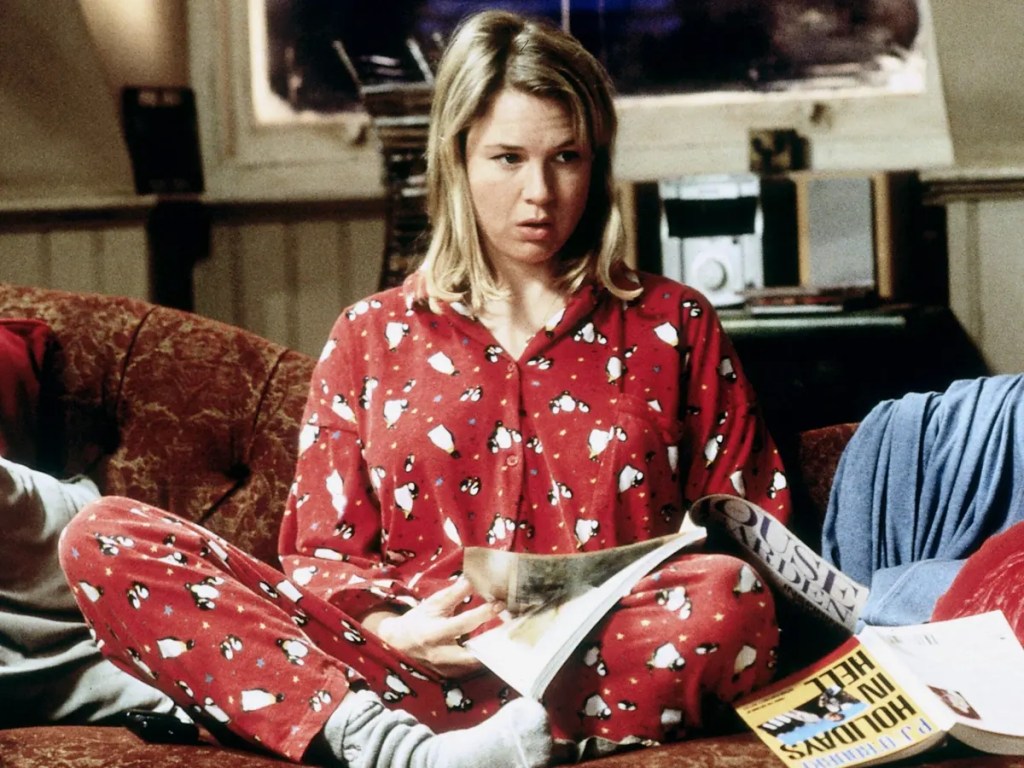
Whether Bridget Jones’s Diary is a Christmas film or not has been a debate for some time now. While the whole film takes place over the course of a year and its various seasons, it begins at a Christmas party and ends in the Christmas snow. Bridget, a 32-year-old single woman portrayed by Renée Zellweger, sets on a journey to change herself and ultimately her life, chronicling this process in detail in her diary. Her desire for change arises from a Christmas party at her parents’ house where she overhears her childhood acquaintance, played by Colin Firth, telling his mother that Bridget couldn’t be a worse fit for him. So, she decides to quit smoking, drinking, lose weight and find herself ‘The One’ in the upcoming year. Nonetheless, with different experiences, we see how her goals and aspirations for herself change throughout the year.
This film, like arguably many other Christmas films, is as much about love and togetherness as it is about loneliness. It’s about the beauty and agony of being single over the holiday period. Not just without a romantic partner, but sometimes without family too. Bridget is left alone to pick up all the pieces.
Yet Christmas is just as much about forgiveness. By the end of the year, Bridget accepts herself and her family, all her and their mistakes. She also learns that all those around her accept her too and always loved her just the way she is. Her friends applaud her blue soup while Firth’s character shyly admits he liked her all this time she was trying to change herself. What is a better ending to a Christmas movie than running into the snowy cold in your pyjamas to declare your love and reunite in a kiss? Turns out, love can even overlook a hideous reindeer sweater.
 reeltalk0.movie.blog