Written by Tom Shepherd
The perfect blend of setting and genre seldom comes to the light of the projector, yet Brick, written and directed by Rian Johnson, casts the single shadow inducing light known as film noir upon the landscape of a Californian high school.
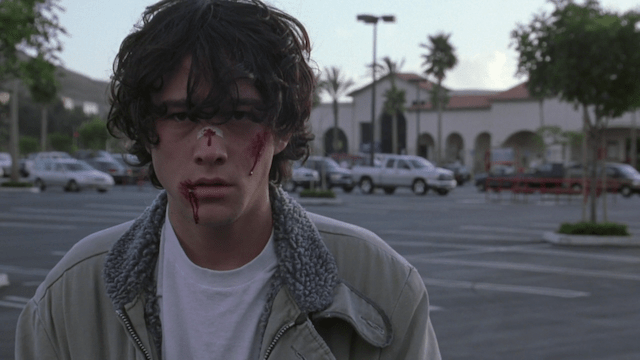
Through this classic narrative that takes inspiration from The Maltese Falcon and Chinatown, the audience follows Brendan (Joseph Gordon-Levitt) as he infiltrates drug gangs, outsmarts muscle and outmuscles smarts to avenge his murdered ex-girlfriend Emily. Skulking from clue to clue, Brendan puts his body on the line to clear him of his own guilt from the past. Negotiating his way through jocks, stoners, popular persons and the vice principal, the camera captures a dark world through Brendan’s perspective, constantly aligning the viewer to his solitary struggle and mental anguish via continual shallow depth of field and point of views. Through his eyes, the school becomes shadowed, full of players in the game of self-interest, including Luara, a classic femme fatale who plays her part of seductress and manipulator. Between Laura, Emily and his past, Brendan’s morality is pushed and pulled to achieve justice, however the price of knowledge takes its toll both mentally and physically.
Johnson’s mastery of film has, in my opinion, yet to be seen again by his hand. As mentioned before, the cameras alignment successfully blends genre and setting through conveying a subjective mise en scene that would otherwise feel spoofy in an objective light. Moreover, the visual effects of camera movement during points of violence in tandem with stylistic editing bring a Guy-Ritchie-Pace to the sometimes mentally focused narrative. Flashes of white, whip pans and dolly affects all liven points of contention and bridge the gap between its serious genre and young-adult setting. On the editing, it shines through to steal several scenes throughout the film and despite the telling low budget aspect of the feature, the professionalism with which it is used fills in many (few) of the cracks of its inadequacy. Another standout element is undoubtedly the sound through which Johnson builds on key motifs such as time and movement while keeping in mind the diegesis of the school. The film has a keen interest in movement as already noted by the camerawork but in terms of its mise en scene, a recurring image of shoes and their performance unlocks nicely introspections of the characters in the ‘show don’t tell’ mindset the film was clearly built from. To further this point brings us to the film’s simultaneous best and worst aspect of dialogue which entrusts the viewer with puzzling the plot out just as Brendan does but is made difficult in cases with a rapid rate of delivery and some mumbling on the actor’s part. With that said, the performances are solid and each play to their archetypical roles well while weaving in the subtlety of their circumstances of being in high school.
 reeltalk0.movie.blog