Written by Dominic Thornton
Paul W.S. Anderson is perhaps not the kind of filmmaker that one would expect to hear a critical revaluation of. Working frequently in the realm of the video game adaptation and genre cinema, his films are widely panned. But, as critic Dave Kehr (one of Anderson’s rare defenders) has noted, “each generation of critics blows it in their own way”. For Resident Evil: Retribution (2012) is not only a splendidly stylish piece of work, but one that also reveals itself as one of the 21st century’s most fruitful works of postmodernism.
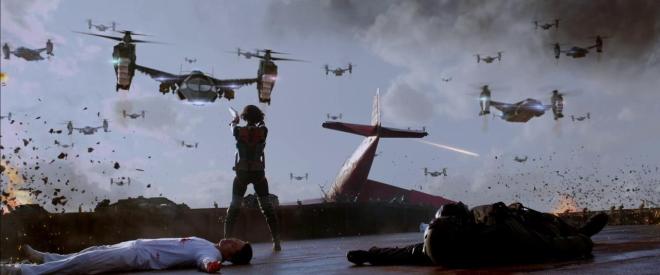
Once again based, at this point extremely loosely, on the video game series of the same name, Resident Evil: Retribution catches up with Alice (last action heroine Milla Jovovich) immediately after the final moments of the previous film, Resident Evil: Afterlife (Dir. Paul W.S. Anderson, 2010). A cold open that picks up where the previous sequel teaser ended, an onslaught atop a cargo ship is relayed in both slow motion and reverse, an immediately stunning piece of spectacle that reveals only the tip of the iceberg of what the film hopes to achieve in relation to genre archetypes, image manipulation and authorial control. What follows is Alice recapping the events of the series thus far, before the iconic close-up of her eye captured by a rotating camera pulling backwards. This Alice is one unfamiliar: long blonde hair and a suburban housewife playing happy families. Yet this cannot last – before long a zombie outbreak occurs, suburbia descends into chaos, and Alice is killed by her zombified husband. Cut to another eye close-up. This is the, presumably, Alice from the opening battle, one who has been captured by the Umbrella Corporation. Soon, the system malfunctions, and Alice is freed from her isolated prison chamber, leaving her to escape what is revealed to be a testing facility that simulates scenarios in mock-ups of real locations (Tokyo, Moscow etc.).
Such a setting facilitates Anderson to take the action wherever he pleases, and he takes great pleasure in transitioning his tableaux action from iconic city to city, via detailed maps and blueprints. Though the action highlight takes place in a simple straight corridor, with Anderson’s flair for space and spatial relations creating a 3D space for Alice to fight a rush of the undead, Jovovich effortlessly moving through each frame as the edit highlights bodies in motion. Most interesting, however, is how such an environment made up of other environments allows the film to remix its own franchise, with scenarios revisited and characters brought back to life (Michelle Rodriguez is the highlight in this regard, portraying two polar opposite characters), as if the previous films were themselves simply simulated test scenarios at the hands of an evil corporation. It is surely no coincidence that Anderson’s innate sense (and love) of geography and spatiality helps draw particular attention to environment, with his compositions that hinge on geometric pleasure appearing particularly astonishing here.
Anderson’s boastful love for genre and commitment to cliché (clichés are, after all, as such for a reason) define him as the 21st century termite artist, digging into the details at hand, in turn producing a treatise on the limits of genre, iconography and the implications of such. It’s interesting that the same week that Resident Evil: Retribution released, fellow Anderson filmmaker Paul Thomas Anderson released The Master (2012) to critical acclaim. There’s an irony here, that the true master was in the multiplex screen next door, detailing his beloved wife fighting zombies in the coolest way possible…
 reeltalk0.movie.blog