Written by Max Bawtree
At the beginning of Bong Joon-Ho’s Memories of Murder (2003), Detective Park Doo-Man is confronted with a child who imitates his every action, expressing that the character, much like the young boy, is the facsimile of a law bringer. Rather than the archetypal morally ambiguous antiheroes which Hollywood has been oversaturated with, Bong Joon-Ho instead chooses to express the irresponsibility and belligerence that this blind approach to justice inevitably will cause. Even when the film introduces Park’s foil, the by-the-book and duty-bound Seo Tae-Yoon, it is not so the two can come to a begrudging comprise and reconcile their differences. Instead, we watch Seo slowly corrupted until he is yet another ruthless and careless arm of the law. Whilst the utterly deplorable actions of the characters seem to all be in the pursuit of justice, it is their own perceived superiority that leads to their ineptitude.
These moments are expressed not just through subtle and deeply human moments (such as the flustered hysteria of the three detectives as they continuously lose their suspect in a foot chase), but also with the wry, comedic overtness which can be seen as a staple of Bong’s work. When we watch the male detectives completely disregard the far superior work of the female officer Kwon Kwi-ok or Park looking for shaven men at the bathhouse, we feel exhaustedly frustrated, the humour deriving from a kind of schadenfreude at their hopeless attempts at detective work. Despite the film being darkly comical in nature, Memories of Murder stays perpetually imbued with a deeply gruesome and disturbing quality which is unshakeable from the reveal of the first horribly brutalised body. With each new victim, suspect or piece of information we feel the twist of the knife, never being given a moment of respite from the almost spectral quality of the murderer. Ambiguity is ultimately what corrupts the film, never giving the viewer any objective truth, leaving the theorising and judgement as much on the shoulders of the viewer than the characters that they are watching.
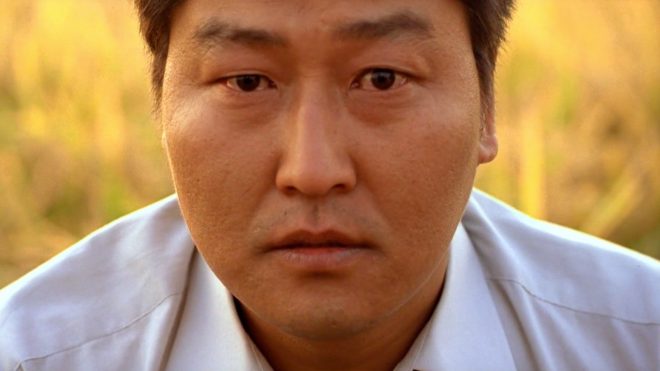
This all culminates in the gut-wrenching final act of the film, which leaves the audience in a state of complete and utter loss, each character left without catharsis or finality, the lack of evidence and moral truth tearing apart these already beaten and broken characters, who are forced ultimately to concede against the enemy they have been chasing throughout the entire film. To me, by far the most chilling moment in the film is its epilogue, in which Park revisits the scene of the first crime, only to discover that the murderer had returned but, looked so ubiquitously normal he would be impossible to find. With this, Park looks directly into camera, suddenly bridging the gap between the fictionalised world of the film and reality. Now, we realise that depraved, disturbed individuals are not confined to the silver screen, but all around us, completely indistinguishable from the masses. There is no reassurance, no comforting final note, only a grim depiction of the corruption which the world seems perpetually filled with, whether it’s in the those the deplorable and untraceable evils which exist in those potentially so closest to us, or the systems put in place keep us from their harm.
 reeltalk0.movie.blog