Written by Leann Rivera
“Have fairytale princesses all disappeared?”
-The First King
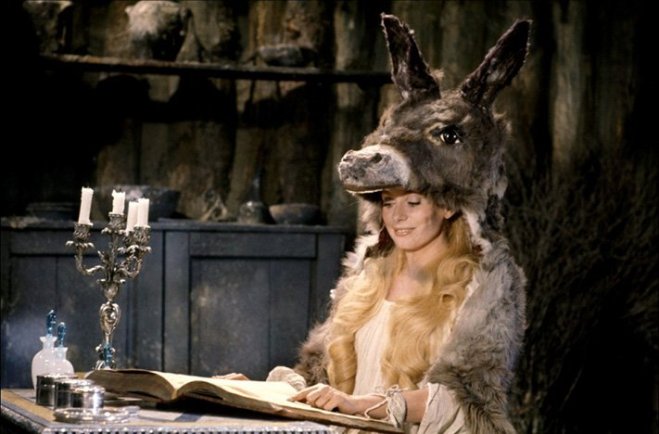
In this age of modernity, where the ‘fairytale’ has immensely developed and watered down to be culturally sterilised through the naive, romanticised portrayals of Disney, Donkey Skin / Peu d’Âne (Jacques Demy, 1970) is a filmic example that works in opposition by exerting a surrealist, twisted approach. Revising its 1695 prose origins by famous fable writer Charles Perrault, this technicolour musical illustrates the French tale in a new and vividly striking – perhaps, even nightmarish way through Demy’s signature, whimsical, camp style. In a sense, enabling spectators to embrace and scrutinise both the genre’s traditional beauty and mythicism alongside its dark, moral undertones and messages closely, which can potentially be easily overlooked due to the abundance of visual pleasure the genre evokes and its escapist and nostalgic connotations which appeals to spectators.
The story could be described as a narrative maze, with its outlandish charm and excess of fantastical imagery, to describe it in words would be rather futile. Nonetheless, in summary, it takes place in a faraway Blue Kingdom where its omnipotent King decrees he is to marry his daughter, the Princess (Catherine Deneuve), after his wife’s tragic passing. Perplexed, the Princess seeks counsel from her fairy godmother, The Lilac Fairy, who after dissuading her from agreeing to such an incestuous union (“girls do not marry their daddies”), entasks her with various impossible pleas she must make to stall, consequently leading her to demand the prized skin of the King’s magical donkey that she uses to run away with disguised as a lowly scullery maid. What follows her then is social torment as the townsfolk derogatorily name her ‘Donkey Skin,’ that is, until the neighbouring Red Kingdom’s Prince discovers her and inevitably falls in love. It leads to a whirlwind romance where at a point, they even astral-project themselves into a rousseauistic rendezvous planning their future together to which they eat a plethora of pastries and share a joint. Eventually, they find each other through a Cinderella-esque ring try-on which concludes the film in a jovial family reunion where all ends harmoniously between the two kingdoms.
Certainly, from this brief overview alone, one might acknowledge why such a fairytale would not be approved by the likes of Disney any time soon, with its dip-dive into ‘adult’ themes of incest and hedonism. Yet, what makes this film so fundamentally enjoyable and fascinating is in fact, that – Demy’s unapologetic trivialisation of such socially taboo matters. His application of enchanté effectively compliments this notion as the meshing together of highly-stylised fantastical imagery such as the heavenly grandiose meadow of flora and fauna, the lavishly decorated boat the couple sail away on the stream with, to the youthful, tranquil pastel colour palette complemented with the use of spoken-song (Sprechgesang), that call out the serious, pressing matters at hand, creates a significant juxtaposition. One that is to be discoursed and challenged, as cliché as it may sound, to understand that there is more than meets the eye.
The film’s tone and depictions are undoubtedly arbitrary, at times even random and unnecessary with its lavishness which would suggest its narrative’s purpose is lost. However, perhaps it is this way to challenge our internalised indoctrination to a heteronormative society. One that has sheltered us from seeing fairytales as nothing more than childish pleasure instead of an ideal tool for initiating difficult conversations about the world around us in order to integrally better the life and the self. Similarly, we like our princess protagonist must endure hardship and acknowledge that patience is a virtue than succumb to our ignorance to choose the route which is easier but immorally wrong.
 reeltalk0.movie.blog