Written by Jonty Hyde
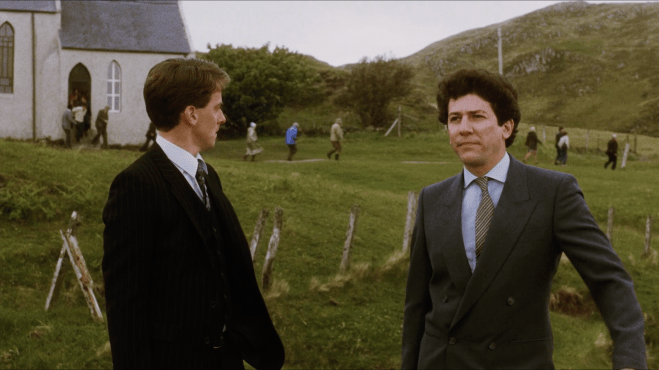
Behind the American hyper-consumerism and glamour of the 1980s, Local Hero invites you to see and partake in a different pace of life, chronicling an American oil worker’s journey to a remote town in Scotland. With its folklore inspired setting and anachronisms, it is therefore a film that is simultaneously timeless whilst remaining critically timeful with its focus on communication, technology, and loneliness.
Yet the film never feels too saccharine or overly sincere. Bill Forsyth maintains a reserved but effective tone with an absurd sense of humour, with its most inspired, thoughtful moments arising out of looks and images often unaccompanied by dialogue. In this sense it feels very “un-American” (un-Hollywood). The humour is mainly situational, worked into the film through clever frame composition and silent cinema inspired movements rather than just witty, over the top dialogue, although, the dialogue of the film is also incredibly funny with brilliant timing from the cast.
Lancaster plays a larger than life Texan oil Tycoon who is belittled by an overly pushy therapist, however, this relationship is perhaps the film’s greatest weakness, with the eccentric tendencies of the therapist feeling a little too over the top and out of place in what is usually a very reserved, delicate film. Lancaster’s role is small but pivotal, with his role as the big American ‘star’ of the film brilliantly mobilised in contrast with the ‘smallness’ of the Scottish townsfolk.
In its critique of American corporate life and materialism in general, Local Hero touches on much larger issues of finding meaning in an ever-changing world, of discovering love and passions in an increasingly sterile environment. The film is a romantic one. The romance between Capaldi’s Oldsen and Jenny Seagroves Marina is charming and believable, as is the unspoken relationship between Riegert and Stella. By never leaning too hard into its romances, you are invited to join in the process of falling in love, as opposed to simply observing the drama.
You can tell there is a genuine love between the camera and the environment, with a desire to capture Scotland’s beauty and the beauty of the people who live in it. This beauty is essential to the anti-materialist thesis of the film, yet the film never feels like it is preaching its message, it conveys it through its charm and raw cinematic skill. The symbols of the film; the beach, telephone box, long sunsets, city skyline all feel expressionist whilst deeply impressionist, they are spaces that are captured fleetingly but in those moments they are filled with intense bursts of emotion that they endure and linger in your mind. Mark Knopfler’s score brilliantly matches this tone.
By the end of the film, Forsyth has wonderfully constructed a fictional but believable vision of a community that stands in for Scotland, but also small towns everywhere. It feels like home, and the tantalising final shots brilliantly drive the themes of the film home. The ambiguity of the ending is perhaps the brightest star in the ending’s cold, dark sky.
 reeltalk0.movie.blog