Written by Owais Azam, Edited by Harry Russell
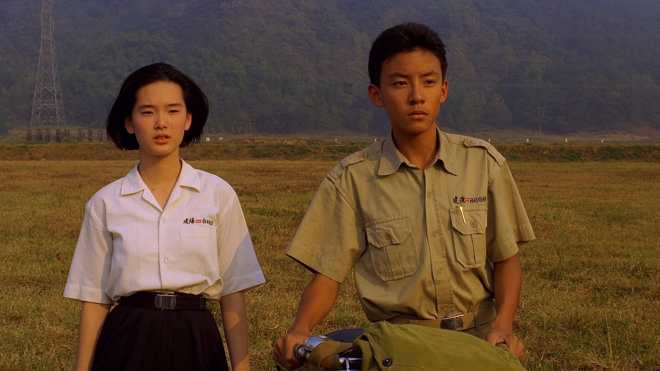
Edward Yang’s 4-hour long A Brighter Summer Day (1991), set against the backdrop of the political, social and cultural ambiguity of Taiwan between 1959 and 1963, explores the gradual demise of Xiao Si’r (Chang Chen) from innocence to delinquency, and the hostile world around him with incredible finesse.
Perfectly paced, A Brighter Summer Day guides its viewer through the lives of its characters with incredible confidence, patience and engrossing tenacity, despite its daunting runtime. On the surface, the film can be seen as an alienated youth-delinquent coming-of-age teen drama (probably one of the best made) yet it’s much more. Yang uses the character of Xiao Si’r as a vehicle through which he comments on the cultural, social and political atmosphere of Taiwan, from which he further explores class tensions, job status, ethnic identity, Western influence on Eastern culture, societal displacement, loss, longing, loyalty, heartache and more. The culmination of this rich canvas is not only a disturbingly depressing depiction of a muddled Taiwan but also an in-depth examination of the complexity of the human condition; or more specifically, a cautionary tale highlighting the detrimental consequences of having little guidance and minimal hope in a time and place where it’s needed most. The film’s characters loiter hopelessly in their environment, waiting for direction and purpose with few places where this can be provided, but one being in gang affiliation – another unstable territory with inevitable detrimental consequences. Xiao Si’r, dipping in and out of various gang tensions and rivalries, unable to find a steady place in his world, epitomises the failed Taiwanese teenager. His disastrous final action ultimately solidifies his bleak fate, while simultaneously offering the audience an intricate view into the time and place the film was set; a lens tinted with realism and shrouded in the pessimism of its context.
Perhaps most impressive of all is that, despite tackling such dense themes, Yang’s masterpiece remains a surprisingly mellow watch. This is owed to his meticulous and patient direction which has proved influential to the likes of many (including Paul Dano, who adopts similar ‘Yangian’ director tropes in his debut, Wildlife). One technique Yang uses to achieve this sense of tranquillity – that he also utilises in his later film, Yi Yi (2000) – is that of leaving the camera static when characters walk in and out of frame. Doing so creates a meditative atmosphere, not akin to that of Terrence Malick’s The Tree of Life whereby Emmanuel Lubezki’s handheld Steadicam style cinematography emulates ethereal fluid motion to create a sense of otherworldliness, but more so to create a grounded realism that crafts a tender and melancholic ambience which transforms us into a more than passive observers. We become a part of the film’s fabric, almost as if we’re not just watching a film, but actually listening in on conversations by putting our ear to the wall or attempting to read a room by making out brief silhouettes of people through the reflection of a door. We are involved in unravelling each of the characters’ stories.
Yet, despite this calm disguise, A Brighter Summer Day keeps a firm grip on its viewer’s attention, shoving us into the lives of its lost characters whose futile search for guidance and identity in their alien surroundings leaves them lingering in isolation – a common theme of Taiwanese Slow Cinema, masterfully perfected here. Yang’s frequent use of full shots seem to be the pillars he uses to illustrate such loneliness; he frames his characters as minuscule in comparison to their hostile and intimidating environment, through which he reinforces the idea that, unable to change their surroundings, his characters can only wait for their surroundings to change them.
 reeltalk0.movie.blog