Written by Dominic Thornton, Edited by Harry Russell
I have a confession. I never used to get Michael Mann. Sure, Heat is acclaimed for good reason, and The Last of the Mohicans was exposed to me in fragments – a product of it being my Dad’s favourite film. The final nine, breathtakingly cinematic, minutes are ingrained in my mind. But his journey into a digital aesthetic didn’t quite click, as Public Enemies unimpressed, and my initial viewing of Blackhat convinced me it was a mess conceived by a director in his twilight years who’d clearly lost it. Then Miami Vice happened.
There’s an immediacy to Miami Vice. If the in medias res opening accompanied by the finest needle- drop of its kind (Jay-Z and Linkin Park’s ‘Numb/Encore’) is a clue, the rooftop Miami skyline that spans as far as the eye can see gives the full picture.
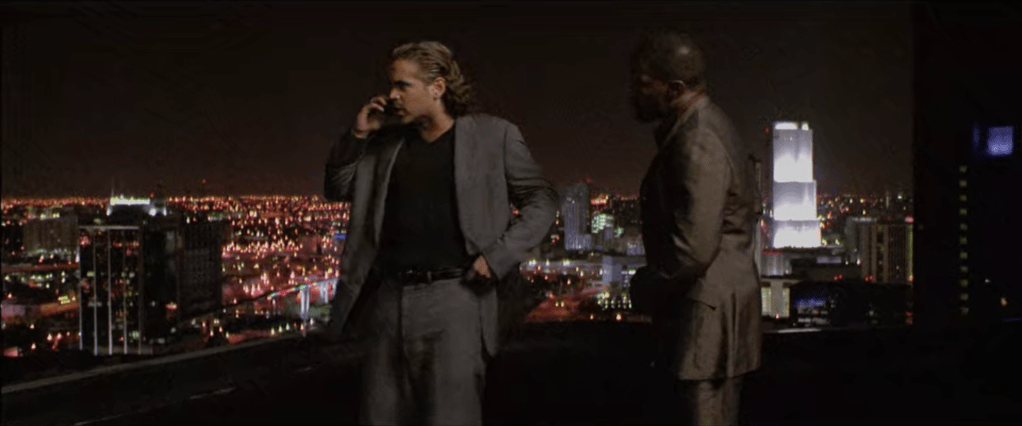
Digital photography becomes Mann’s obsession and aesthetic shift. The man who defined the style and aesthetic of the 1980s can’t be blamed for attempting to pioneer that of the 2000s. But people weren’t interested. The hyperrealist lyrical quality of Mann’s images in this period just couldn’t replace the lack of plot, even if the images did the storytelling and emotion for him. As Harmony Korine said of Miami Vice, “I could feel the place… I don’t even pay attention to what they’re saying or the storyline. I love the colours, I love the texture.” Miami Vice represents love in a digital hurricane, the humidity that drips off the screen threatening heartbreak. Public Enemies takes the digital technology a step further, while Mann seemingly returns to familiar ground. On paper, Public Enemies sounds like a period piece Heat, a game of cat and mouse as cops chase robbers, Mann’s signature ‘two sides of the same coin’ hinted at in plain sight. It could never live up to such expectations on an initial watch. Then a second chance occurred.
This is digital era Mann, and Public Enemies is less interested in past obsessions. Just like Colin Farrell’s Sonny Crockett in Miami Vice, Johnny Depp’s John Dillinger must become accustomed to his new surroundings. The digital photography makes it crystal clear: it’s at direct odds with the film’s period setting, production and costume design. There’s a grating disconnect between the film’s world and the way it’s presented. As Dillinger exits prison, he too finds himself disconnected from the new world he enters. An ardent professional proud of his distinct skillset (he can run through a bank in “1 minute, 40 seconds… flat”), Dillinger finds a world where technology has advanced so that a man can make more money in mere seconds through telecommunications than one could sticking up a bank. A man lost and unsure of his position, to misquote Hall & Oates, “He’s out of touch. He’s out of time.”
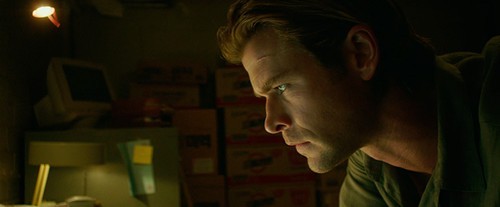
The critical and commercial failure of Blackhat exposes Mann. Seeing the box office totals you can practically hear Mann yelling, “but I put Thor in it. What do you people actually want?!?”. Mann finds himself just as lost as his protagonists, perhaps the reason Chris Hemsworth appears to be doing an impression of Mann’s voice. Granted, films about hackers are so 1990s, yet Blackhat is the first film to feel like it could directly throw you into a computer screen.
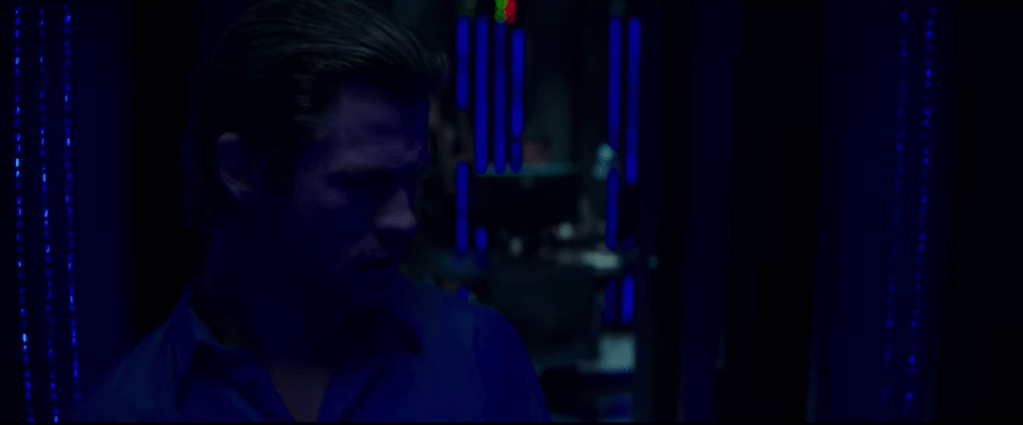
The digital photography works slightly differently here than it does in Miami Vice and Public Enemies. While yes, there is the advancement of technology on display, whereas his previous films demonstrated characters finding themselves in new surroundings through a digital sensor, Blackhat additionally finds Mann hurling his protagonists into a blend of reality meeting digital. Early on, it appears like Blackhat will make the same tired mistake every film about hackers makes, yet through the eye of Mann, a repetition becomes altered. Mann has long been obsessed with city landscapes at night, ever since 1981’s Thief. As the camera shoots through a computer, showing its inner workings, it evokes and replicates those city landscapes, mimicking the city blocks and skyscrapers that reflect the very source that lights them. The landscape of towering skyscrapers and city blocks that come later perfectly transform into the digital grid that Hemsworth’s Nick Hathaway traverses.
The glances shared between characters, free from any barrier that celluloid once burdened, perfectly encapsulate their emotions and feelings towards one another. These sensations are only heightened by the lack of control imposed on individuals by the binary code that defines this modern world. The individual bodies are framed as part of a collective that, once dispatched, are abandoned like obsolete commodities – the result of capitalistic systems. I may be in love with Miami Vice, yet Mann’s obsession and control over the digital is even more attuned here. If Miami Vice is a film that leaves you behind the minute you escape its wavelength, Blackhat is a film that doesn’t even stop to let you get on. Mann’s form connects and fits a tale just like the code of its subject. He continues his evolution of shoot outs, setting the bar of its respective genre with Heat and then becoming liberated with the visceral qualities offered by the versatile digital cameras of Miami Vice. The sharp, intense sound of gunfire in sync with the flawed images capture the pops of nozzle flair. At times Blackhat appears like a distant cousin of a Tony Scott venture, albeit without the mosaic editing that blessed Scott’s canvas. Mann has consistently sunk deep into research and detail when it comes to accurately portraying the professions his protagonists occupy. Maybe that’s the key to Mann: this desire for authenticity and realism combined with the natural progression that is sensory expressionism.
“Power wanes, and though digital entities may rule, as individuals in this system, we’re all we’ve got.”
I’m acutely drawn to the build-up of the final confrontation. As Mann’s camera shares the gaze of Tang Wei’s Chen Lien, we stare longingly at Hathaway as he creates a stab vest consisting of magazines and a makeshift shank out of a screwdriver. Hathaway started as a digital soldier with a keyboard as a weapon. He ends with weapons that are practically analogue – almost tribal in nature. It all comes full circle. Power wanes, and though digital entities may rule, as individuals in this system, we’re all we’ve got. As the final confrontation commences, lit entirely by flaming torches (for all intents and purposes an analogue system), Hathaway proclaims, “this isn’t about zeros, or ones, or code”. It never was. It’s the reason Mann’s camera lingers intimately, highlighting every touch, every gesture, every stare shared. Just as Crockett and Isabella hold each other at the end of Miami Vice: “Time is luck”. Mann’s protagonists try to cling onto the final seconds – the brief pause allowed – of a moment that the system won’t allow. These very moments are accentuated by the digital sensor, no longer bound by the enclosed celluloid. His obsessions may be in digital, yet he never lost sight of the humanity caught up in it.
As Jonathan Rayner states in The Cinema of Michael Mann: Vice and Vindication, “Principles of individual value upheld by Mann’s protagonists are defined, defended and defeated within a modern lived environment which is inhospitable, even antithetical to the aspirations of personal fulfilment.” (2013: 63). Blackhat remains Mann’s most optimistic film. The shift that takes place during the third act may force grieving to be delayed, individuals may be reduced to statistics and digits flowing through cables, and the system is too far gone to be destroyed. But perhaps maybe, we can escape it together.
Maybe it was more than a defining surface aesthetic that Mann was chasing. Like his protagonists Sonny Crockett, John Dillinger and Nick Hathaway, Mann found himself traversing unfamiliar surroundings, operating in a world that changes faster than we can keep up. Perhaps then, what he found was the defining trait of living in this modern world. “No one’s ever gotten this close before”. No one has since…
Miami Vice and Blackhat are currently streaming on Netflix whilst Public Enemies is currently streaming on Amazon Prime in the UK.
 reeltalk0.movie.blog
2 thoughts on “Blackhat and Michael Mann’s Digital World”